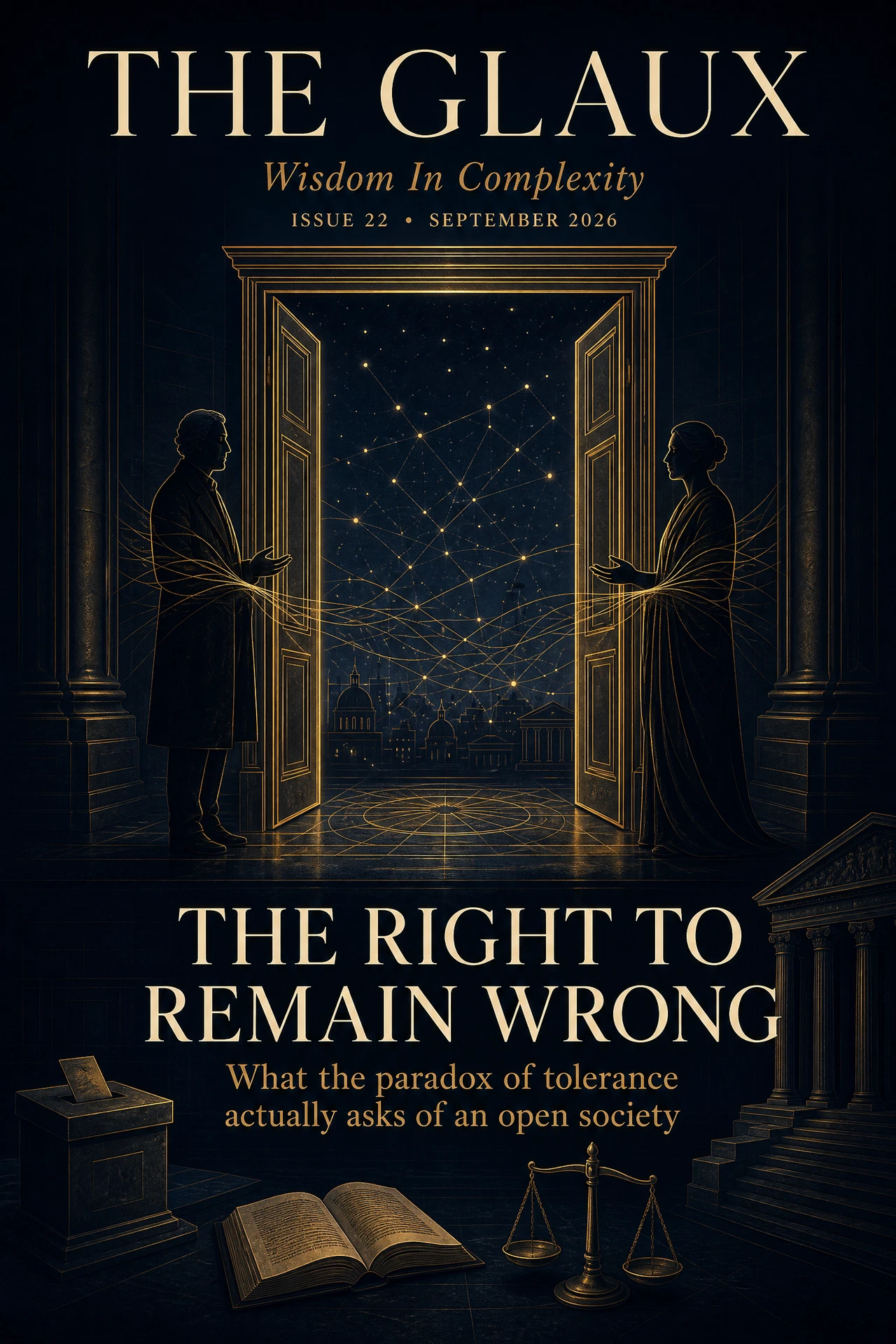
The Door Left Open
Imagine a political movement that asks for every protection available in a constitutional democracy: the right to organise, to speak, to recruit, to contest elections, to criticise the state, and to persuade its fellow citizens. It then makes a different proposition about the future: once it has sufficient power, elections will no longer be meaningfully competitive; certain opponents will no longer enjoy equal standing; dissent will no longer be something the public order is obliged to protect.
The immediate instinct is to close the door. A democracy that admits an actor committed to ending democracy appears naïve — a house offering shelter to the fire that will consume it. Yet closing the door raises an equally serious question. Who decides, in advance, which conviction is too dangerous to enter? And what prevents the power to identify “intolerance” from becoming a mechanism for suppressing a faith, a minority, an unpopular theory, or a political opposition that has committed no coercive act at all?
This is Karl Popper’s paradox of tolerance, often repeated in a form he did not quite offer. In The Open Society and Its Enemies, Popper did not argue that every intolerant opinion should be prohibited. His concern was narrower and more demanding: an open society may need to reserve the right to defend itself when rational discussion has been displaced by intimidation, violence, or an effort to prevent opponents from speaking at all. [1]
The distinction matters because contemporary debate often collapses four different things into one: holding a belief others find objectionable; advocating that belief in public; seeking constitutional change through lawful means; and using power to remove others’ equal ability to participate. These are not morally identical, institutionally identical, or democratically identical. A society that cannot distinguish them will either persecute conviction or surrender its own conditions of survival.
The deeper question, then, is not whether democracy should tolerate its enemies. It is whether democracy can preserve the conditions of disagreement without requiring everyone to agree about the final truth.
Conviction Is Not Domination
Every plural society contains people who believe that their own moral, religious, philosophical, or political account of the world is not merely preferable but true. This is not a problem to be solved. It is a condition to be understood.
“God’s law is higher than state law for me” can coexist with constitutional democracy. So can the conviction that secularism is spiritually impoverished, that a prevailing moral consensus is mistaken, or that the constitution should be amended. Democracy does not ask its participants to empty their deepest commitments of content before they enter public life. It asks something more limited and more difficult: that they accept other citizens’ equal political standing even where they believe those citizens are profoundly wrong.
That distinction is often missed in debates about religion and politics. Liberal states sometimes describe themselves as neutral, while quietly treating public religious reasoning as a problem to be managed. But no political order is entirely neutral about the questions that matter most. Secular legal frameworks organise public life around their own historical assumptions about conscience, authority, injury, and acceptable speech. Saba Mahmood’s work on religious difference is useful here precisely because it makes the apparent neutrality of these frameworks visible. [2]
The reverse error is equally consequential. A movement may begin from a sincere conviction that divine, national, revolutionary, or historical law outranks positive law. That conviction becomes a constitutional question only when it is translated into a claim that dissenters may no longer reject it politically; that they may be compelled to conform; or that they may lose the institutional means to reverse a decision through ordinary democratic contest.
The decisive line is not intensity of belief. It is the treatment of the dissenter once power changes hands.
This framing does not make the problem easy. It makes it precise. The task is not to inspect consciences for suspect content. It is to protect a civic arrangement in which consciences can remain different without any one of them acquiring a permanent right to govern the others as subjects rather than citizens.
Popper’s Fine Print
Popper’s paradox is sometimes reduced to a slogan: intolerance must not be tolerated. The slogan is memorable, but it obscures the architecture of his argument.
Popper maintained that intolerant philosophies should generally be met by rational argument and public opinion so long as their advocates remain willing to participate in those forms of contest. The threshold changes when a movement rejects argument as such and reaches for fists, weapons, intimidation, or the deliberate silencing of its opponents. At that point, the issue is no longer whether the movement has a mistaken view. The issue is whether the conditions under which mistaken views can be answered are being destroyed. [1]
This is why the paradox is not really about tolerance as a sentiment. It is about the infrastructure of nonviolent revision. Elections, independent courts, free association, a press capable of scrutiny, equal citizenship, lawful opposition, and the ability to criticise those who govern — these are not decorative features around democracy. They are the machinery that lets a society correct itself without demanding that one side erase the other.
Karl Loewenstein developed a related idea in the 1930s under the name “militant democracy.” Watching elected institutions become instruments through which fascist movements dismantled constitutional government, he argued that a democracy may be entitled to defend the legal order that makes democratic competition possible. [3] But the phrase carries its own danger. A democracy that becomes militant without restraint may eventually defend not constitutional openness but the preferences of whichever group currently controls the state.
The question is therefore not whether defensive democracy is legitimate. Every constitutional order already practises it in some form: it prohibits political violence, protects the independence of courts, criminalises intimidation, and sets rules against election interference. The harder question is whether its defences remain targeted at conduct that destroys reciprocity — or drift toward suppressing people merely because they are disturbing, devout, radical, unpopular, or difficult to govern.
The Bargain Beneath Democracy
Democracy is frequently described as majority rule. This is true only at its most superficial level. A bare majority can impose a decision; it cannot, by that fact alone, create a democratic order.
The deeper bargain is more reciprocal: today’s majority accepts that it may become tomorrow’s minority, and today’s minority accepts that it can remain a participant while it waits, organises, argues, and tries again. The winner receives authority, not ownership. The loser yields the office, not the right to exist politically.
James Madison understood the danger of faction not as an unfortunate deviation from republican life but as something native to it. His argument in Federalist No. 10 was not that factions would disappear through enlightenment. It was that a sufficiently large and plural republic could prevent any single faction from too easily converting its passion into permanent domination. [4]
This is the hidden deal under every workable democracy: defeat has to remain survivable. A citizen who loses an election must still be able to speak, publish, worship, associate, litigate, vote, and imagine a future in which the next election matters. When this confidence disappears, politics becomes existential. Losing no longer means accepting an adverse outcome within a shared game. It means anticipating exclusion from the game itself.
Chantal Mouffe calls the constructive form of this relationship agonism: opponents are not friends, and their conflict may be profound, but they recognise one another as legitimate adversaries rather than enemies who must be eliminated. [5] This is a demanding achievement. It asks people to accept not that their opponents are right, but that their opponents retain the right to be wrong in public.
The paradox of tolerance is therefore inseparable from the paradox of defeat. A society can make room for fierce disagreement only if neither side treats victory as permission to ensure the other side can never recover.
When Defence Learns the Wrong Lesson
The danger of constitutional surrender is visible. The danger of excessive defence is harder to see because it often arrives in the language of safety.
Governments and institutions can say: these ideas are intolerant, therefore their advocates may be excluded. The progression can be gradual. First, the state targets explicit threats and coercive conduct. Then it treats provocative advocacy as evidence of likely coercion. Then it treats association with a controversial view as evidence of dangerous intent. Eventually, the public order may preserve the appearance of tolerance while narrowing the range of views that can be held without social or institutional penalty.
This is not an imaginary risk. International IDEA’s 2025 assessment of global democracy records broad declines in representation, rule of law, press freedom, and judicial independence, while the V-Dem Institute’s 2026 report similarly identifies democratic backsliding inside previously stable democracies. [6] [7] The mechanisms vary across cases, but the recurring pattern is instructive: democratic erosion commonly proceeds through legal procedures, administrative redesign, and exceptional measures that appear justified in the moment.
The open society’s vulnerability is thus double. It may be captured by forces that use freedoms instrumentally in order to abolish them later. Or it may hollow itself out while attempting to identify and neutralise those forces pre-emptively.
The two failures are not mirror images. One abandons constitutional restraint in the name of a final truth. The other abandons constitutional restraint in the name of protecting pluralism. But both alter the same underlying relation: the dissenter ceases to be a citizen whose rights survive disagreement and becomes an object to be managed.
This is why behavioural thresholds matter. Belief can be expansive, awkward, and even offensive without constituting domination. The relevant democratic question is not whether a view makes others uncomfortable. It is whether its holders are using — or credibly organising to use — coercion, intimidation, systematic exclusion, political violence, or institutional capture to make reciprocal disagreement impossible.
The Difference Between a Boundary and a Wall
An open society needs boundaries. A society with no rules against violence, threats, electoral sabotage, political coercion, or the destruction of equal legal standing is not more tolerant. It is simply less capable of protecting the people within it.
But a boundary and a wall serve different purposes. A boundary defines the conditions under which a shared space can remain shared. A wall defines who is permitted to belong in the first place.
The difference is institutional, not rhetorical. A boundary is public, narrow, contestable, and tied to observable conduct. It says: you may hold this view, advocate it, and seek to persuade others; you may not use force, organised intimidation, or control of the state to remove others’ capacity to contest you. A wall is vague, preventive, and identity-based. It says: because we anticipate that people like you may be dangerous, your participation is conditional from the outset.
The first model is difficult. It requires independent courts capable of reviewing state action, due process capable of distinguishing evidence from suspicion, and a public culture capable of enduring speech that provokes genuine distress. The second model is administratively tempting. It shifts uncertainty from institutions to individuals: instead of proving conduct, authorities classify people. Yet it is precisely this shift that turns democratic self-defence into an instrument of arbitrary power.
John Stuart Mill’s defence of liberty remains relevant not because all speech is harmless, but because silencing an opinion deprives a society of a process of correction. The opinion may be true; it may contain a portion of truth; or its contestation may keep a prevailing truth from becoming a dead dogma. [8] The point is not that every utterance deserves equal amplification. It is that a society loses epistemic capacity when it makes settled approval the condition of participation.
The goal is neither a public square without limits nor a public square purged of risk. It is a constitutional space in which limits protect the possibility of disagreement rather than protect the comfort of a settled majority.
Repairing the Conditions of Disagreement
There is no formula that solves the paradox once and for all. Its difficulty comes from the fact that democratic openness and democratic self-protection are both necessary, and each can damage the other when treated as absolute. The work is one of calibration.
Make thresholds conduct-based, specific, and reviewable. Laws concerning political violence, coercion, intimidation, election interference, and threats to equal citizenship should identify observable actions rather than rely on ideological labels. Independent judicial review is essential because governments are poorly positioned to be the sole judges of threats to their own authority. The constraint is that harmful campaigns are often gradual and indirect. The failure mode is either waiting until coercion is irreversible or expanding the definition of danger until peaceful opposition is treated as a security problem.
Build anti-capture safeguards around democratic continuity. Electoral administration, courts, public-service professionalism, independent media, and lawful opposition need protection not because they are above politics but because they preserve politics as a revisable process. This can include transparent appointment procedures, dispersed authority, fixed institutional terms, and clear protections for opposition rights. The constraint is legitimacy: safeguards that appear to remove all public control can become an elite veto. The failure mode is defending institutions in a way that makes them less accountable and therefore less trusted. [9]
Use reciprocity tests for public power. Parties and leaders can be assessed not by whether they hold strong views but by whether they accept the continued rights of opponents: certified elections, peaceful transfers of power, equal legal protection, judicial independence, and freedom of association. This is not a loyalty test to a single ideology. It is a test of whether political competition will remain possible after victory. The constraint is enforcement. Declarations of commitment are cheap; institutional compliance is not. The failure mode is using the test selectively against disliked factions while excusing similar conduct by allies.
Create deliberative spaces with institutional consequence. Citizens’ assemblies, cross-community forums, and deliberative polling do not eliminate disagreement. Their value is different: they make it possible to discover what changes when people encounter opposing commitments under conditions other than performance and panic. James Fishkin’s work suggests that structured deliberation can generate more informed and less reflexive public judgments. [10] The constraint is scale and time. The failure mode is turning deliberation into civic theatre whose conclusions have no relationship to actual decisions.
None of these measures provides certainty. They do, however, relocate the question from conscience-policing to institutional design. The task is not to discover who is sufficiently tolerant in their heart. It is to build arrangements that make permanent political exclusion harder for everyone, including the people currently entrusted with preventing it.
The Right to Remain Wrong
The open society does not rest on the hope that everyone will agree about justice, God, nation, history, or the good life. It rests on a narrower and more durable proposition: nobody gets to settle those questions by permanently removing everyone else’s capacity to answer.
That proposition is fragile because it asks for a form of restraint that becomes hardest to sustain when conviction is strongest. It asks a religious believer to defend the political freedom of a secular dissenter; a secular institution to defend the public standing of religious conviction; a majority to preserve the mechanisms through which it may be defeated; a minority to accept outcomes it considers mistaken without abandoning the possibility of future persuasion.
There are cases in which a constitutional order has to act to defend itself. Political violence, systematic intimidation, forced conformity, the destruction of independent adjudication, and the abolition of meaningful elections are not simply viewpoints in a marketplace of ideas. They are actions that attempt to close the marketplace itself.
But self-defence becomes legitimate only by remaining recognisable as defence. It has to be limited by law, tested by evidence, open to challenge, and directed toward conduct that destroys reciprocal citizenship rather than toward identities or convictions that unsettle the governing consensus.
The question a democracy must keep asking is simple enough to state and difficult enough to govern by: what happens to the person who disagrees once you have power?
The answer reveals whether a movement is seeking to win an argument, govern for a time, and remain answerable to others — or whether it is seeking to end the condition in which arguments, governments, and answers can still change.
The right to remain wrong is not a concession made by a confident society to people it regards as mistaken. It is the condition by which a society remains capable of discovering that it, too, may be wrong.
References
- Popper, Karl. The Open Society and Its Enemies, Vol. 1: The Spell of Plato. Routledge, 1945; revised edition, 1966. Note 4 to Chapter 7 sets out the original formulation of the paradox of tolerance.
- Mahmood, Saba. Religious Difference in a Secular Age: A Minority Report. Princeton University Press, 2016.
- Loewenstein, Karl. “Militant Democracy and Fundamental Rights, I.” American Political Science Review 31, no. 3 (1937): 417–432.
- Madison, James. Federalist No. 10. 1787.
- Mouffe, Chantal. Agonistics: Thinking the World Politically. Verso, 2013.
- International IDEA. The Global State of Democracy 2025: Democracy on the Move. 2025. https://www.idea.int/publications/catalogue/html/global-state-democracy-2025-democracy-move
- V-Dem Institute. Democracy Report 2026: Unraveling the Democratic Era? University of Gothenburg, 2026. https://www.v-dem.net/documents/75/V-Dem_Institute_Democracy_Report_2026_lowres.pdf
- Mill, John Stuart. On Liberty. John W. Parker and Son, 1859.
- Levitsky, Steven, and Daniel Ziblatt. How Democracies Die. Crown, 2018.
- Fishkin, James S. Democracy When the People Are Thinking: Reviving Our Politics Through Public Deliberation. Oxford University Press, 2018.