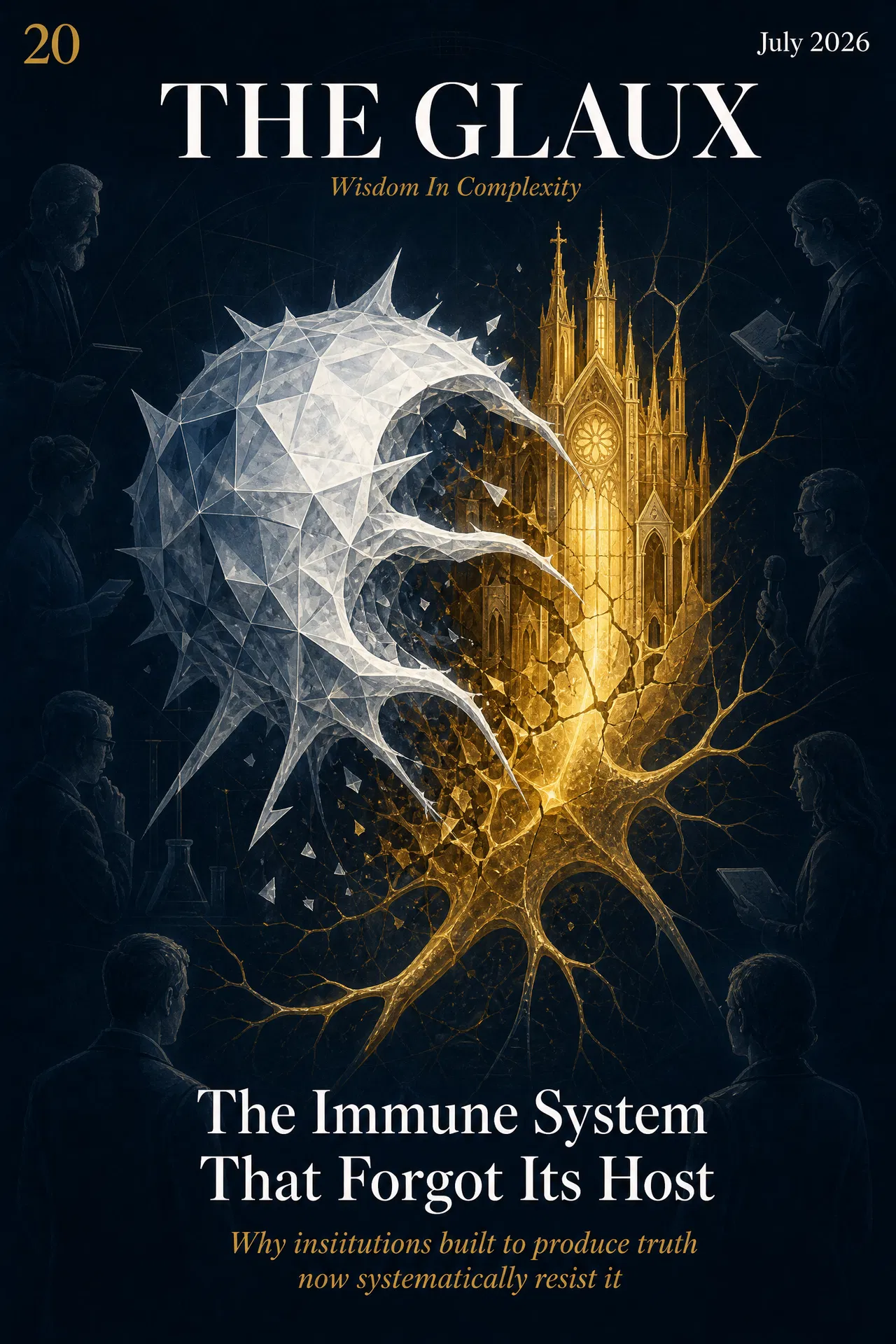
The Organism and Its Defence
Every complex organism develops an immune system. The immune system's function is to distinguish self from non-self — to identify what belongs and what threatens, and to neutralise the latter before it can cause damage. This is not a moral function. It is a survival function. The immune system does not ask whether the foreign body is good or bad. It asks only: does this belong here?
Institutions develop immune systems too. A university, a scientific journal, a newspaper, a regulatory body — each develops over time a set of mechanisms for distinguishing legitimate participants from illegitimate ones, acceptable ideas from dangerous ones, insiders from outsiders. These mechanisms are not always explicit. They operate through hiring committees, peer review, editorial judgment, funding allocation, citation networks, conference invitations, and the thousand small signals that tell a person whether they are inside or outside the circle of the credible.[1]
For most of an institution's life, this immune system serves its host. It filters out charlatans, maintains standards, and protects the accumulated knowledge of the field from being contaminated by noise. The institution's immune system and the institution's purpose are aligned.
The problem begins when they diverge.
When the Defence Becomes the Disease
An immune system that has been running for long enough begins to make a characteristic error. It starts treating the host's own cells as foreign bodies. In medicine, this is called autoimmune disease. The immune system, having successfully defended the organism for decades, begins to attack the tissue it was designed to protect.
Institutional immune systems make the same error — and for the same structural reason. The longer an institution has been selecting for a particular kind of participant, the more its immune system comes to identify that type as “self” and everything else as “non-self.” The university that has spent fifty years selecting for consensus-sensitive, methodologically orthodox researchers will eventually develop an immune system that treats methodological heterodoxy as a threat — not because heterodoxy is wrong, but because it is foreign.[2]
This is not a story about bad people. The individuals operating these immune systems are, in the main, conscientious. They believe they are protecting standards. They are — but standards have drifted from “produces true and important knowledge” toward “resembles the kind of knowledge we have always produced.” The immune system is still functioning. It has simply forgotten what it was built to protect.
Eric Weinstein has described this as the suppression of “portal figures” — thinkers whose work crosses disciplinary boundaries, challenges foundational assumptions, or arrives from outside the credentialled hierarchy.[3] The observation is correct, but the mechanism is more interesting than the description implies. It is not that institutions are hostile to genius. It is that they are structurally unable to distinguish between a disruptive truth and a disruptive error — and in the face of that uncertainty, they default to suppression. The cost of admitting a false positive (a wrong idea) is visible and immediate. The cost of suppressing a true positive (a correct but uncomfortable idea) is invisible and deferred. Institutions, like all organisms, optimise for the visible and immediate.
The Selection Gradient
The deeper problem is not what institutions do to outsiders. It is what they do to insiders over time.
Every institution exerts a selection pressure on the people within it. The question is: what does it select for? In a young institution, the answer tends to be: results. The institution is still small, its survival is uncertain, and the people who rise are those who produce the most value — the most important discoveries, the most compelling journalism, the most rigorous science. The institution's internal politics are not yet elaborate enough to reward political skill over productive skill.
As the institution matures and its survival becomes more secure, the selection gradient shifts. The institution now has a bureaucracy, a hierarchy, a set of internal norms, a reputation to protect, and a funding base to maintain. The people who rise in this environment are not necessarily those who produce the most important work. They are those who best navigate the institution's internal politics — who know when to challenge and when to defer, who build coalitions, who avoid making powerful enemies, who frame their work in ways that are legible and unthreatening to the people who control resources.[4]
This is not corruption. It is adaptation. The institution is selecting for the traits that are most useful for institutional survival. The tragedy is that these traits are systematically different from the traits most useful for truth production. The skills that make a person an effective institutional operator — social sensitivity, risk aversion, consensus orientation — are precisely the skills that make a person a poor detector of paradigm shifts. Paradigm shifts require the willingness to be wrong in public, to challenge people with more status, to hold an unpopular position for years before it is vindicated. These are not the traits that institutional selection rewards.
Over decades, this gradient produces a particular kind of institution: one staffed by intelligent, credentialled, well-intentioned people who are structurally incapable of producing the kind of knowledge that the institution was built to produce.[5]
The Printing Press Problem
This is not a new problem. It is a recurring one.
When Gutenberg's press made it possible to reproduce text at scale, the Catholic Church faced a version of the same crisis. The Church had spent a thousand years as the primary institution for the production and distribution of knowledge in Western Europe. Its immune system was highly developed — it knew how to distinguish legitimate theology from heresy, authorised commentary from dangerous innovation. The printing press did not change the Church's immune system. It changed the environment in which that immune system operated.
The Church's response was the Index Librorum Prohibitorum — a list of forbidden books, maintained for four centuries.[6] The Index was not irrational. From the perspective of the institution's immune system, it was the correct response: identify the foreign bodies, catalogue them, and prevent their circulation. The problem was that the foreign bodies included Copernicus, Galileo, Descartes, and Locke. The immune system was working perfectly. It was protecting the institution from the ideas that would eventually make the institution's authority obsolete.
The parallel to the present is not exact. But the structure is recognisable. Contemporary institutions of knowledge production — universities, scientific journals, mainstream media — are facing a version of the printing press problem. The internet has made it possible to produce and distribute ideas outside institutional channels at near-zero cost. The institutional immune systems are responding in the way immune systems respond: by tightening the criteria for what counts as legitimate, by strengthening the signals that distinguish insiders from outsiders, by increasing the cost of association with heterodox ideas.[7]
This response is coherent from the institution's perspective. It is also, historically, the response that precedes institutional collapse.
The Autoimmune Cascade
The autoimmune metaphor extends further than it might appear.
In medicine, autoimmune diseases are self-reinforcing. The immune system attacks healthy tissue; the body responds to the damage by triggering more immune activity; the increased immune activity causes more damage; the cycle accelerates. The disease does not reach a stable equilibrium. It escalates until something external intervenes — a treatment that recalibrates the immune system's targeting — or until the damage becomes irreversible.
Institutional autoimmunity follows the same cascade. As the institution's immune system becomes more aggressive in suppressing heterodox ideas, the most productive heterodox thinkers leave or are excluded. Their departure makes the institution more homogeneous. A more homogeneous institution has a less accurate model of what constitutes a genuine threat versus a genuine innovation. Its immune system becomes less discriminating — more likely to suppress anything that feels unfamiliar, regardless of its actual merit. The institution becomes less capable of producing the knowledge it was built to produce. Its credibility erodes. As its credibility erodes, it becomes more defensive. The cycle continues.[8]
What makes this cascade particularly difficult to interrupt is that it is invisible from inside the institution. The people operating the immune system are not suppressing ideas they recognise as important. They are suppressing ideas they genuinely believe are wrong, or premature, or dangerous, or simply not up to standard. The immune system has recalibrated its definition of “standard” so gradually that no single step in the recalibration was visible as a departure. The institution looks, from inside, exactly as it always did. The change is only visible from outside — or in retrospect.
Redesigning the Targeting System
The instinct, when confronted with a malfunctioning immune system, is to suppress it entirely. This is the wrong response in medicine, and it is the wrong response in institutional design. A suppressed immune system leaves the organism vulnerable to genuine threats. The goal is not to eliminate the institution's capacity for self-defence but to recalibrate its targeting — to rebuild the distinction between threats to the institution and threats to the truth.
Adversarial review structures. Standard peer review asks: does this work meet the field's existing standards? An adversarial structure asks a different question: is there any argument that this work is correct, even if it violates existing standards? The two questions produce different selection pressures. Adversarial review would not replace standard review but would create a parallel track for work that fails on the first question but might succeed on the second. The constraint: adversarial review is expensive and requires reviewers willing to argue against their own field's consensus. The failure mode: it becomes a second track for work that is simply wrong but politically convenient.[9]
Structured heterodoxy quotas in funding. A small proportion of research funding — perhaps five percent — allocated specifically to work that challenges the foundational assumptions of its field. The mechanism: proposals are evaluated not on whether they are likely to succeed but on whether, if they succeeded, they would require the field to revise its foundations. The constraint: defining “foundational challenge” without creating a loophole for pseudoscience. The failure mode: the quota becomes a political instrument rather than an epistemic one.
Institutional divorce between production and evaluation. The current structure conflates the production of knowledge with its evaluation — the same institutions that produce research also control the journals that evaluate it, the conferences that disseminate it, and the hiring committees that reward it. Separating these functions — creating evaluation institutions that are structurally independent of production institutions — would reduce the conflict of interest that drives autoimmunity. The constraint: evaluation institutions would themselves develop immune systems over time. The failure mode: the separation creates a new bureaucracy without solving the underlying selection problem.
Reputation systems that reward revision. The current incentive structure rewards being right the first time and penalises changing one's mind. A reputation system that explicitly rewarded updating — that treated public revision as a sign of intellectual integrity rather than weakness — would reduce the cost of admitting error and therefore reduce the defensive behaviour that drives autoimmunity. The constraint: distinguishing principled revision from opportunistic capitulation. The failure mode: the system is gamed by people who update strategically rather than honestly.
None of these interventions is sufficient alone. Each addresses a symptom of the underlying selection problem without fully resolving it. The deeper question — how to maintain an institution's immune system while preventing it from turning against the institution's purpose — does not have a clean answer. It is a problem of ongoing calibration, not a problem that can be solved once and left alone.
The Calibration That Never Ends
There is a version of the Weinstein argument that is essentially a complaint: institutions have been captured by the wrong people, and the solution is to replace them with the right people. This version is not wrong, exactly, but it is incomplete. It treats the problem as a personnel problem when it is an architectural one.
The deeper observation is that the tension between institutional survival and truth production is not an aberration. It is a structural feature of how institutions age. Every institution that has ever existed has faced some version of this tension. The Catholic Church faced it. The Royal Society faced it. The peer-reviewed journal system faces it now. The question is not how to create institutions that are immune to this tension — that is impossible — but how to create institutions that can recognise when the tension has become pathological and correct for it before the autoimmune cascade becomes irreversible.[10]
This is a question about institutional self-awareness. Can an institution develop the capacity to observe its own immune system from the outside — to ask not just “is this idea legitimate?” but “are our criteria for legitimacy still aligned with our purpose?” This is a harder question than it sounds, because the people best positioned to ask it are usually the ones the immune system has already excluded.
The history of knowledge production suggests that the answer, when it comes, rarely comes from inside the institution. It comes from the printing press. It comes from the internet. It comes from the people who were excluded and built something else. The institution then faces a choice: adapt its immune system to the new environment, or defend the old one until it is no longer relevant.
That choice is not made once. It is made continuously, in thousands of small decisions about who to hire, what to publish, which ideas to take seriously, and which to dismiss. The institutions that survive are not the ones that got the immune system right. They are the ones that kept asking whether it was still right.
References
- Kuhn, Thomas S. The Structure of Scientific Revolutions. University of Chicago Press, 1962.
- Merton, Robert K. “The Normative Structure of Science.” In The Sociology of Science. University of Chicago Press, 1973.
- Weinstein, Eric. “The Portal” podcast, various episodes, 2019–2023. Weinstein’s concept of “portal figures” — thinkers whose work crosses disciplinary boundaries and is systematically excluded by institutional gatekeeping.
- Smolin, Lee. The Trouble with Physics: The Rise of String Theory, the Fall of a Science, and What Comes Next. Houghton Mifflin, 2006.
- Ioannidis, John P. A. “Why Most Published Research Findings Are False.” PLOS Medicine 2, no. 8 (2005).
- Eisenstein, Elizabeth L. The Printing Press as an Agent of Change. Cambridge University Press, 1979.
- Turchin, Peter. Ages of Discord: A Structural-Demographic Analysis of American History. Beresta Books, 2016.
- Taleb, Nassim Nicholas. Antifragile: Things That Gain from Disorder. Random House, 2012.
- Popper, Karl. The Logic of Scientific Discovery. Hutchinson, 1959.
- Habermas, Jürgen. The Theory of Communicative Action. Beacon Press, 1984.