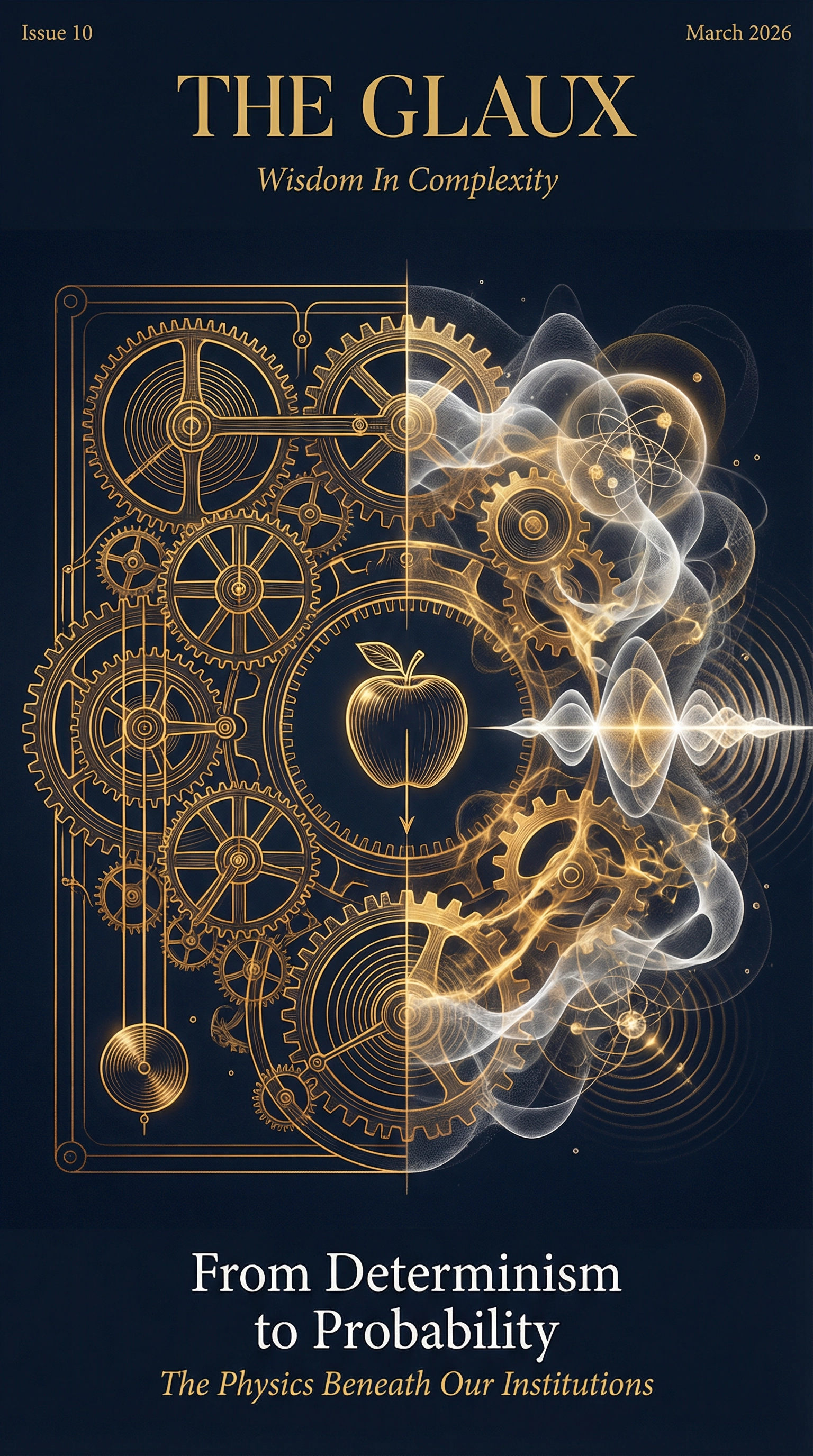
The Cosmology We Inherited
Every civilization runs on invisible software. Not the kind stored on servers or written in code, but the kind embedded in assumptions — about how causes produce effects, how knowledge relates to control, how individuals stand in relation to systems, and how uncertainty should be handled. This software is rarely articulated. It operates beneath the level of policy debate and institutional design. It is, in the deepest sense, philosophical infrastructure.
For roughly three centuries, the dominant version of this software was Newtonian. Isaac Newton's mechanics, published in 1687, did not merely describe the motion of planets and pendulums. It encoded a set of propositions about reality that proved extraordinarily generative: the universe is orderly, predictable, and in principle fully knowable. Causes produce proportional effects. Systems can be decomposed into parts, each part analyzed, then reassembled. The observer stands apart from the observed. Given sufficient information, control is achievable.
These propositions migrated out of natural philosophy and into every domain of organized human life. They shaped how factories were designed, how states were administered, how legal responsibility was assigned, how economic risk was calculated, and how scientific authority was legitimated. The Newtonian worldview did not merely describe the physical world — it became the template for the social world.
Then, in the early twentieth century, physics changed. Quantum mechanics dismantled each of the Newtonian pillars, one by one. The universe, at its most fundamental level, is not deterministic but probabilistic. The observer does not stand apart from the observed — the act of measurement participates in producing the outcome. Systems cannot always be decomposed without remainder; entangled particles share states that have no local description. Identical causes do not always produce identical effects. Certainty, even in principle, has a ceiling.
The question this article examines is not whether quantum mechanics is "true" in some final sense. It is whether the civilizational software installed by Newtonian physics remains adequate for a world that, in its social and informational dynamics, increasingly resembles quantum rather than Newtonian behavior. And if the answer is no — which there are serious reasons to suspect — what follows from that?
The Machine That Ran the World
To understand what Newtonian civilization built, it helps to trace the assumptions rather than the artifacts. The artifacts — factories, railroads, bureaucracies, legal codes — are visible. The assumptions that made them feel natural and inevitable are less so.
The first assumption is predictability through decomposition. A Newtonian system can be understood by breaking it into its constituent parts, analyzing each part, and summing the results. This is the logic of the assembly line, the organizational chart, the legal code, and the diagnostic manual. Complex phenomena are treated as aggregates of simpler ones. Mastery of the parts implies mastery of the whole.
The second assumption is linear causality. Effects are proportional to causes. Small inputs produce small outputs; large inputs produce large outputs. This is the logic behind economic forecasting, risk actuarial tables, and the legal doctrine of proximate cause. If you can identify the cause, you can assign responsibility. If you can model the inputs, you can predict the outputs.
The third assumption is observer independence. The scientist, the judge, the auditor, the regulator — each is imagined as a neutral observer who can examine a system without altering it. Objectivity is not merely an aspiration but an ontological claim: there is a fact of the matter, and a sufficiently careful observer can access it without contamination.
The fourth assumption is the sufficiency of information. Uncertainty, in the Newtonian frame, is epistemic rather than fundamental. We are uncertain because we lack information, not because the world is irreducibly indeterminate. Given enough data, prediction becomes possible. Given enough prediction, control becomes achievable.
These four assumptions, taken together, produced what might be called the architecture of mastery: the conviction that the world is, in principle, manageable — that with enough knowledge, enough organization, and enough authority, human institutions can bring complex systems under reliable control. The achievements of this architecture were genuine and enormous. The Newtonian operating system, whatever its limits, ran the world with considerable success for three centuries.
What Quantum Mechanics Actually Disturbed
The quantum revolution is often described in terms of its strangeness — particles that are in two places at once, cats that are simultaneously alive and dead, measurements that seem to reach backward in time. These descriptions are not wrong, but they obscure what is most significant for the present argument.
What quantum mechanics disturbed, at a foundational level, was not the furniture of the world but the epistemological relationship between observer and system. The disturbance operates along four axes that directly mirror the Newtonian assumptions described above.
| Newtonian Assumption | Quantum Disruption |
|---|---|
| Decomposable into parts | Entanglement resists decomposition without loss |
| Linear causality | Probabilistic outcomes — same conditions, different results |
| Observer-independent | Measurement participates in producing the outcome |
| Uncertainty is epistemic | Uncertainty is fundamental (Heisenberg's ceiling) |
The question, again, is not whether these features of quantum mechanics apply literally to social systems. They do not, in any direct sense. Social institutions are not quantum systems. But the question is whether the epistemic posture that quantum mechanics demands — probabilistic, observer-participatory, resistant to decomposition, humble about the limits of prediction — is better suited to the social and informational dynamics of the present than the Newtonian posture it displaced.
Two Psychologies of Civilization
The deepest consequence of a dominant physics is not institutional but psychological. It shapes what people expect from the world, what they feel entitled to demand from institutions, and how they respond when those expectations are frustrated.
Newtonian civilization produced what might be called a psychology of mastery. Its characteristic features are: confidence in the power of analysis to resolve complexity; expectation that problems have solutions if approached with sufficient rigor; trust in expert authority as the legitimate custodian of objective knowledge; and a tendency to experience uncertainty as a temporary condition — a gap in knowledge that will eventually be filled.
This psychology is not pathological. It drove the construction of genuinely effective institutions. But it has characteristic failure modes. It tends to mistake the map for the territory — to treat models as reality rather than approximations of it. It tends to underestimate the role of the observer in constructing the phenomena being observed. It tends to respond to complexity by adding more decomposition rather than questioning whether decomposition is the right tool. And it tends to treat persistent uncertainty as a sign of institutional failure rather than as a feature of the domain.
The quantum worldview, if it were to install a psychology, would produce something quite different: a psychology of navigation. Its characteristic features would be: comfort with irreducible uncertainty; attention to the ways in which the observer's position shapes what can be seen; recognition that some systems cannot be fully decomposed without loss; and a disposition toward resilience and adaptation rather than prediction and control.
This psychology is not passive or defeatist. It does not abandon the project of understanding or the aspiration to act effectively. But it holds its models more lightly. It expects surprise. It designs for robustness rather than optimization. It treats the limits of knowledge not as a temporary embarrassment but as a permanent feature of the epistemic landscape.
The tension between these two psychologies is visible in contemporary institutional life. Central banks that treat economic forecasting as a precision instrument, then are repeatedly surprised by crises their models did not anticipate. Legal systems that assign individual responsibility for harms produced by complex, distributed systems. Intelligence agencies that collect vast quantities of data on the assumption that more information will eventually yield reliable prediction. In each case, the Newtonian operating system is running on a world that increasingly exhibits quantum-like dynamics: nonlinearity, emergence, observer effects, and fundamental limits on predictability.
The Mismatch and Its Costs
The central claim of this article is not that quantum mechanics is a metaphor for social complexity. It is that the epistemic posture appropriate to quantum systems — probabilistic, participatory, humble about decomposition, resistant to false certainty — is increasingly appropriate to the social and informational systems that contemporary institutions are trying to govern.
Consider three domains where the mismatch is most visible. Financial systems have been the site of the most explicit confrontation between Newtonian and quantum-like dynamics. The models that dominated risk management in the decades before the 2008 financial crisis were built on Gaussian distributions, linear correlations, and the assumption that historical data provided reliable guidance for future probabilities. The crisis demonstrated, at enormous cost, that financial systems exhibit fat tails, nonlinear contagion, and emergent dynamics that no decomposition of individual institutions could have predicted.
Digital information ecosystems present a second domain of mismatch. The governance frameworks applied to social media, algorithmic recommendation, and digital misinformation were largely designed with Newtonian intuitions: identify the harmful content, remove it, assign responsibility to the publisher. But digital information systems exhibit observer effects (the act of measuring engagement shapes what content is produced), nonlocal correlations (content that is harmless in one context becomes harmful in another), and emergent dynamics that cannot be attributed to any single actor. The decomposition-and-attribution approach has proven persistently inadequate.
Governance of complex sociotechnical systems — from pandemic response to climate adaptation to AI deployment — presents a third domain. These systems are characterized by deep uncertainty, observer effects, and emergence. Governing them with Newtonian tools — detailed ex ante rules, precise impact assessments, individual accountability for distributed harms — produces institutions that are simultaneously over-specified and under-prepared. The cost of the mismatch is a particular kind of institutional fragility: systems optimized for the world their models describe, and therefore brittle when the world behaves differently.
Instruments for a Different Cosmology
What would it mean to design institutions with a quantum-like epistemological posture? This is not a question with clean answers — which is itself consistent with the posture being described. But several directions of inquiry are worth naming.
Probabilistic governance frameworks would treat uncertainty as a design parameter rather than a problem to be eliminated. Rather than requiring precise impact assessments before action, they would specify acceptable ranges of uncertainty and build in mechanisms for rapid revision as evidence accumulates. The difference is between a bridge designed to carry a specific load and one designed to remain functional across a range of conditions, with sensors that trigger maintenance before failure. Regulatory sandboxes, adaptive management regimes, and iterative rulemaking are early experiments in this direction, though they remain exceptions rather than the norm.
Observer-aware institutional design would take seriously the ways in which measurement and monitoring change the systems being governed. This is not a new insight — Goodhart's Law, Campbell's Law, and the Lucas critique all describe versions of it — but it has not been systematically incorporated into institutional design. An observer-aware approach would ask, as a standard question: how does the act of measuring this outcome change the behavior of actors in the system?
Resilience over optimization as an explicit design criterion would shift the target of institutional performance. Newtonian institutions are typically optimized for a specific outcome under specified conditions. Quantum-posture institutions would be designed to remain functional across a wider range of conditions, accepting lower peak performance in exchange for robustness to surprise. This is the logic of redundancy, modularity, and slack — features that Newtonian efficiency thinking tends to eliminate as waste, and that quantum-posture thinking would treat as essential.
Distributed authority structures would recognize that in complex, nonlinear systems, centralized control is both epistemically limited and fragile. This does not mean the elimination of authority, but its distribution across multiple nodes with different information, different perspectives, and different failure modes. None of these directions is without costs and failure modes. The quantum posture does not dissolve the tensions of institutional design; it reframes them.
What the Transition Does Not Resolve
The argument of this article has a structure that deserves explicit acknowledgment: it suggests that a shift in epistemic posture — from Newtonian to quantum-like — would improve the fit between institutions and the systems they govern. This is a claim that should be held with the same probabilistic humility it recommends.
The first unresolved tension is between accountability and complexity. Legal and democratic systems are built on the assumption that responsibility can be assigned — that there is, in principle, an actor who caused a harm and who can be held to account for it. A quantum-posture approach that distributes causality across complex systems and treats outcomes as emergent rather than intended may be epistemically more accurate, but it risks dissolving the accountability structures on which legitimate governance depends.
The second is the tension between expertise and participation. The Newtonian model of expert authority — the neutral observer with privileged access to objective knowledge — has been substantially eroded. A quantum-posture approach that takes observer effects seriously and distributes epistemic authority more widely does not automatically produce better collective knowledge. It may produce cacophony. The conditions under which distributed, observer-aware epistemology produces reliable collective knowledge rather than coordinated confusion are not well understood.
The third is the tension between adaptation and stability. Institutions derive much of their value from predictability and continuity. A legal system that changes its rules in response to every new piece of evidence is not a legal system in any meaningful sense. The quantum posture's emphasis on revision, adaptation, and holding models lightly runs up against the legitimate institutional need for stability and predictability. How to build institutions that are adaptive without being arbitrary is a design problem that the quantum posture names but does not solve.
The Civilization That Is Still Being Built
Newton taught that if you know enough, you can control the world. This was not a cynical claim. It was an expression of genuine optimism about the power of human reason to master nature and, by extension, to master the conditions of human life. The civilization it produced was, in many respects, a remarkable achievement.
Quantum mechanics teaches something different: that even in principle, knowledge has a ceiling, and that the act of knowing participates in shaping what is known. This is not a counsel of despair. It is a different kind of optimism — one that locates human agency not in the mastery of a fixed and knowable world, but in the capacity to navigate a world that is irreducibly uncertain, participatory, and surprising.
The civilization that is still being built — if it is being built — will need institutions adequate to this different kind of world. Not institutions that have abandoned the Newtonian achievements of planning, scaling, and coordination, but institutions that hold those achievements within a more honest account of what knowledge can and cannot deliver.
The question is not whether we can afford to make this transition. The question is whether we can afford not to. The mismatch between Newtonian institutional software and quantum-like social dynamics is producing visible, costly failures in the governance of financial systems, information ecosystems, and complex sociotechnical change. What kind of civilization emerges from taking quantum uncertainty seriously — not as a physics lesson, but as an epistemological posture — remains genuinely open. That openness is not a deficiency. It is, perhaps, the most honest thing that can be said about the present moment.