The Inversion of Scarcity
The software industry was built on a foundational premise: code is costly to produce and valuable to own. For decades, companies created moats through proprietary technology, network effects, and switching costs. SaaS businesses scaled by selling access to functionality that users could not easily replicate. The value proposition was clear—pay for what you cannot build yourself.
Generative AI inverts this logic. When a language model can generate functional code in seconds, when image synthesis tools produce professional-grade visuals on demand, when entire application interfaces can be scaffolded through natural language prompts, the scarcity that justified software pricing evaporates. The cost of production approaches zero. The barrier to entry collapses. What was once a defensible asset becomes a commodity.
This is not merely a pricing problem or a competitive threat. It is a fundamental reordering of where value resides. If software can be generated at will, then owning software is no longer the source of leverage. The question becomes: what remains scarce when creation is abundant? The answer is not technological—it is human. Judgment, taste, context, trust, and the capacity to discern what matters—these cannot be automated away, because they are not functions to be optimized. They are emergent properties of conscious engagement with complexity.
The opportunity in this space is not to build better software. It is to redesign the infrastructure of value itself, shifting from ownership of artifacts to stewardship of processes, from selling products to enabling coherence, from extracting rents to facilitating alignment. The companies that thrive will not be those that resist commoditization, but those that recognize it as the precondition for a new economic architecture.
The False Binary: Defend or Surrender
The prevailing responses to AI-driven commoditization fall into two camps, each internally coherent but ultimately insufficient.
The first position holds that software companies must defend their moats through proprietary data, vertical integration, and regulatory capture. Proponents argue that while generic functionality may become commoditized, domain-specific expertise, customer relationships, and accumulated data remain defensible. A healthcare SaaS platform may face competition from AI-generated tools, but its value lies in compliance knowledge, integration with legacy systems, and trust built over years of operation. The strategy is to retreat to the parts of the value chain that AI cannot easily replicate—human relationships, institutional knowledge, regulatory navigation. This is a strategy of differentiation through scarcity preservation.
The second position holds that commoditization is inevitable and companies must pivot to becoming platforms, orchestrators, or curators. If AI can generate software, then the value shifts to those who aggregate, evaluate, and deploy AI-generated outputs. Companies become intermediaries—connecting users to the right models, ensuring quality, managing workflows. The strategy is to embrace abundance and position oneself as the interface between generative capacity and human need. This is a strategy of value capture through coordination.
Both positions share a common flaw: they assume that value must be captured through control—either of scarce assets or of distribution channels. They are rent-seeking frameworks applied to a post-scarcity context. The first tries to preserve artificial scarcity. The second tries to extract tolls from abundance. Neither addresses the deeper question: if creation is no longer the bottleneck, what is?
The Reframing: Consciousness as Infrastructure
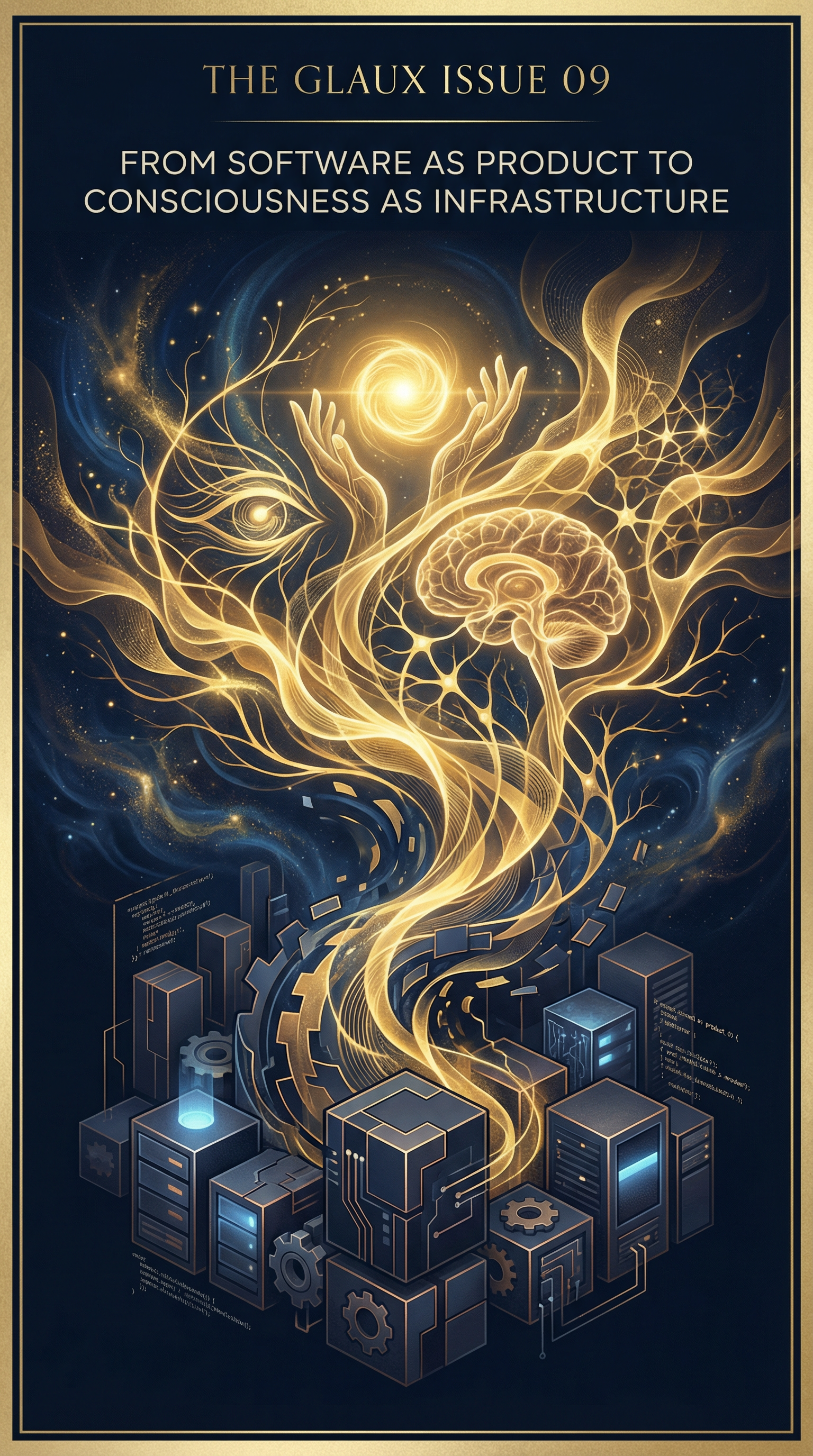
The innovation emerging in response to this impasse is a shift from software as product to consciousness as infrastructure. Rather than asking "what can we build that others cannot?" the question becomes "what processes of attention, discernment, and alignment can we enable that create value beyond the artifact?"
This reframing is enabled by recognizing that the bottleneck is no longer creation, but coherence. In a world where anyone can generate a website, a business plan, a marketing campaign, or a legal contract, the scarce resource is not the output—it is the capacity to evaluate whether the output is fit for purpose, aligned with intent, and integrated into a larger system of meaning. This capacity cannot be automated, because it is not a function of pattern matching. It is a function of situated judgment—the ability to hold context, navigate ambiguity, and make decisions that reflect values, constraints, and long-term consequences.
Companies that recognize this shift are building infrastructure for conscious decision-making, not just tools for task execution. They are creating systems that help users clarify intent, surface trade-offs, test assumptions, and iterate toward alignment. The product is not the artifact—it is the process of arriving at the artifact that matters. The value is not in what is generated, but in the quality of attention brought to the generation process.
This is not a metaphor. It is a design principle. Consider a legal AI that does not simply draft contracts, but helps parties articulate what they actually want from the agreement, surfaces potential conflicts, and facilitates negotiation. The value is not the contract—it is the alignment process that the contract codifies. Consider a business intelligence tool that does not just generate reports, but helps teams ask better questions, challenge their assumptions, and refine their mental models. The value is not the data visualization—it is the cognitive infrastructure that enables better thinking.
What makes this shift significant is that it moves beyond the binary of "build or buy" and acknowledges that the real work is sense-making, not production. AI can produce endlessly, but it cannot discern what is worth producing. It can optimize for stated objectives, but it cannot question whether those objectives are coherent. It can generate options, but it cannot navigate the ethical, strategic, and relational complexity of choosing among them. That work requires human consciousness in the loop—not as a bottleneck to be eliminated, but as the source of value itself.
What Shifts the Weights?
The transition from software as product to consciousness as infrastructure is not inevitable. It depends on several factors that will determine which model prevails.
Market maturity is the most immediate variable. As long as AI-generated outputs are perceived as inferior to human-crafted work, traditional software companies retain their advantage. But as generative models improve—and they are improving rapidly—the quality gap narrows. At some threshold, the marginal value of human craftsmanship becomes negligible for most use cases. When that happens, the market bifurcates: commodity functionality at near-zero cost, and premium services for those who need human judgment. The question is how large each segment will be.
Regulatory environment also matters. If governments impose liability on AI-generated outputs—requiring human oversight, certification, or accountability—then companies that provide that oversight become gatekeepers. If regulation is light or absent, then the market remains open, and value accrues to those who can deliver functionality fastest and cheapest. The trajectory of AI regulation will shape whether consciousness infrastructure becomes a necessity or a luxury.
Cultural norms around trust will play a critical role. If users are comfortable delegating decisions to AI—accepting its recommendations without scrutiny—then the demand for sense-making infrastructure is limited. If, however, there is widespread skepticism about AI's reliability, or a cultural preference for human judgment in high-stakes domains, then the market for consciousness infrastructure expands. This is not just a matter of technology performance—it is a matter of social construction of legitimacy.
Economic incentives will determine which business models scale. If venture capital continues to reward growth over profitability, then companies will optimize for user acquisition and market share, even if their products are commoditized. If investors shift toward sustainable business models, then companies that provide high-value, high-margin services—such as consciousness infrastructure—will attract capital. The funding environment shapes what gets built.
Technological infrastructure will also influence the trajectory. If AI models become so capable that they can autonomously refine their own outputs—iterating toward alignment without human input—then the need for human-in-the-loop systems diminishes. If, however, there are fundamental limits to what AI can do—domains where human judgment is irreplaceable—then consciousness infrastructure becomes a permanent fixture of the economic landscape.
The Ripples Through the Economy
The shift from software as product to consciousness as infrastructure will have profound second-order effects on labor markets, organizational structures, and the broader economy.
Labor markets will be restructured. If the value of work shifts from production to discernment, then the skills that matter change. Technical proficiency in coding, design, or analysis becomes less valuable. The ability to ask good questions, hold complexity, navigate ambiguity, and facilitate alignment becomes more valuable. This is not a simple substitution—it is a reordering of what constitutes expertise. Education systems, credentialing mechanisms, and hiring practices will need to adapt. The transition will be disruptive, and many workers whose value was tied to technical execution will find themselves displaced.
Organizational structures will evolve. If consciousness infrastructure is the source of value, then companies will organize around processes of collective sense-making, not just task execution. Hierarchies designed for command-and-control will give way to networks designed for coordination and alignment. Decision-making will become more distributed, but also more deliberate. The role of leadership will shift from directing work to curating attention—deciding what questions matter, what trade-offs are acceptable, and what values guide the organization.
Power dynamics within industries will shift. Companies that control consciousness infrastructure will have significant leverage. They will shape how decisions are made, what options are considered, and what outcomes are deemed acceptable. This is not neutral. The design of sense-making tools embeds assumptions about what matters, what is measurable, and what is legitimate. If a small number of companies control these tools, they will have outsized influence over how value is created and distributed. This raises questions of governance, accountability, and access.
Innovation dynamics may be constrained or redirected. If AI commoditizes software, then the incentive to invest in new software diminishes. Why build a better tool if AI can replicate it instantly? The focus shifts to meta-innovation—building systems that help others innovate, rather than innovating directly. This could lead to a flowering of new organizational forms, decision-making processes, and coordination mechanisms. Or it could lead to stagnation, if the economic returns to innovation collapse.
Cultural production will be affected in ways that are difficult to predict. If AI can generate content at scale, then human-created work may become more valuable as a marker of authenticity and intentionality. Alternatively, the distinction between human and AI creation may become irrelevant, with audiences caring only about the quality of the experience, not its origin. The role of the creator may shift from producer to curator, from maker to sense-maker.
Experiments in Progress
1. The Alignment Marketplace. A platform could be created where users post problems they need solved, and AI generates multiple solutions. But instead of simply delivering outputs, the platform facilitates a structured process of evaluation—helping users articulate their criteria, surface hidden assumptions, test edge cases, and refine their intent. The value is not the solution—it is the alignment process. The platform charges not for the AI-generated outputs, but for the infrastructure that enables better decision-making. This shifts the business model from selling artifacts to enabling coherence.
2. The Sense-Making Cooperative. A group of professionals—lawyers, consultants, strategists—could form a cooperative that provides human-in-the-loop oversight for AI-generated work. Clients get the speed and cost savings of AI, but with the assurance that a human expert has reviewed, refined, and certified the output. The cooperative does not compete with AI—it complements it. The value proposition is trust and accountability. This model works only if there is demand for human judgment, which depends on regulatory requirements, cultural norms, and the perceived risk of AI errors.
3. The Meta-Tool for Tool-Making. A company could build a system that helps organizations design their own AI-assisted workflows. Instead of selling pre-built software, it sells the capacity to build software—a meta-tool that enables teams to rapidly prototype, test, and deploy AI-generated solutions tailored to their specific needs. The value is not the tool—it is the capability to adapt. This model assumes that customization is more valuable than standardization, which may or may not hold as AI models become more general-purpose.
4. The Consciousness Layer Protocol. A decentralized protocol could be developed that provides standardized infrastructure for human-in-the-loop decision-making. Any AI system could plug into the protocol to request human judgment at critical junctures. The protocol would manage the marketplace for human attention—matching requests with qualified reviewers, ensuring quality, and distributing compensation. This would create a global market for discernment, where the scarce resource is not computation, but conscious engagement. The challenge is ensuring that the protocol is not captured by a small number of actors, and that it scales without degrading quality.
The Uncharted Terrain
The commoditization of software is not a problem to be solved—it is a phase transition in the structure of value. The old model, where value was captured through ownership of scarce artifacts, is giving way to a new model, where value is created through the facilitation of coherence, alignment, and conscious engagement.
This transition is not smooth. It will displace workers, disrupt industries, and challenge assumptions about what work is for. It will create new forms of power and new sites of contestation. The companies that thrive will not be those that resist the transition, but those that recognize it as an opportunity to redesign the infrastructure of value itself.
What is clear is that the bottleneck is no longer creation. It is sense-making. The scarce resource is not computational power or data—it is human attention, judgment, and the capacity to hold complexity. The opportunity is not to build better software. It is to build systems that enable better thinking, better decision-making, and better alignment between intent and outcome.
The terrain is uncharted. The rules are being written. The question is not whether AI will commoditize software—it already has. The question is what comes next. And the answer will be determined not by technology alone, but by the choices we make about what we value, what we build, and how we organize ourselves in a world where creation is no longer the constraint.