THE GLAUX
From Ownership to Attribution
The Collapse of the Boundary
Copyright law rests on a foundational premise: creative works are produced by identifiable human authors who deserve exclusive rights to control and profit from their creations. This framework emerged from centuries of legal evolution, designed for a world where creation was a discrete act—a novelist writing a manuscript, a painter completing a canvas, a composer finishing a score. The creator's labor was visible, the output was distinct, and the chain of authorship was clear.
Generative artificial intelligence disrupts this premise at every level. When a neural network trained on millions of images produces a new artwork, who is the author? Is it the person who wrote the prompt? The engineers who designed the model? The artists whose work was used in training? The company that owns the infrastructure? Or is there no author at all, rendering the output ineligible for copyright protection? The legal system, built on the assumption of human authorship, finds itself unable to answer these questions without fundamentally reconsidering what creation means.
The stakes extend far beyond legal theory. Artists whose work was scraped from the internet to train AI models argue that their labor has been appropriated without consent or compensation. AI companies claim that training on publicly available data constitutes fair use, analogous to how human artists learn by studying the work of others. Meanwhile, users of generative AI tools create millions of images, texts, and compositions daily, many of which are commercially valuable. The existing copyright framework cannot accommodate this reality. It was designed for a world of scarcity—where creative works were costly to produce and distribute—not for a world of algorithmic abundance, where creation happens at scale and speed that human labor alone could never achieve.
Two Irreconcilable Positions
The debate over AI and copyright has crystallized into two opposing camps, each internally consistent but mutually exclusive.
The first position holds that training AI on copyrighted works without explicit permission is infringement. Proponents argue that generative models function as sophisticated copying machines. The model "learns" by internalizing patterns from training data, and when it generates new outputs, it is effectively remixing and reproducing elements of that data. If a human artist were to study thousands of copyrighted images and then produce works that closely resembled them, they could be sued for infringement. Why should an AI system be treated differently? This view emphasizes the economic harm to creators. If AI can produce images, music, or text that compete with human-created works—using those very works as training material—then the original creators are being exploited. Their labor is being used to build systems that may ultimately replace them.
The second position holds that training AI on publicly available data is transformative use and should be protected. Proponents argue that AI models do not store or reproduce training data in any meaningful sense. Instead, they learn abstract patterns—how edges form shapes, how words relate to concepts, how musical phrases create structure. The output of a generative model is not a copy of any specific training example; it is a novel synthesis. This is analogous to how human artists learn. A painter studies the techniques of the masters, internalizes their approaches, and produces original work. No one claims that this constitutes infringement, even though the artist's style is shaped by what they have seen. Moreover, restricting AI training to only licensed data would concentrate power in the hands of a few large companies that can afford to negotiate deals, stifling innovation and locking out independent researchers and smaller firms.
Both positions are defensible within their own frameworks, but they cannot coexist. If training on copyrighted data is infringement, then most existing generative AI systems are built on illegal foundations, and their outputs may themselves be tainted. If training is fair use, then creators lose the ability to control how their work is used, and the economic model that has sustained creative industries for generations is undermined. The legal system is being forced to choose between incompatible visions of how creativity, ownership, and technology should interact.
The Reframing: From Ownership to Attribution
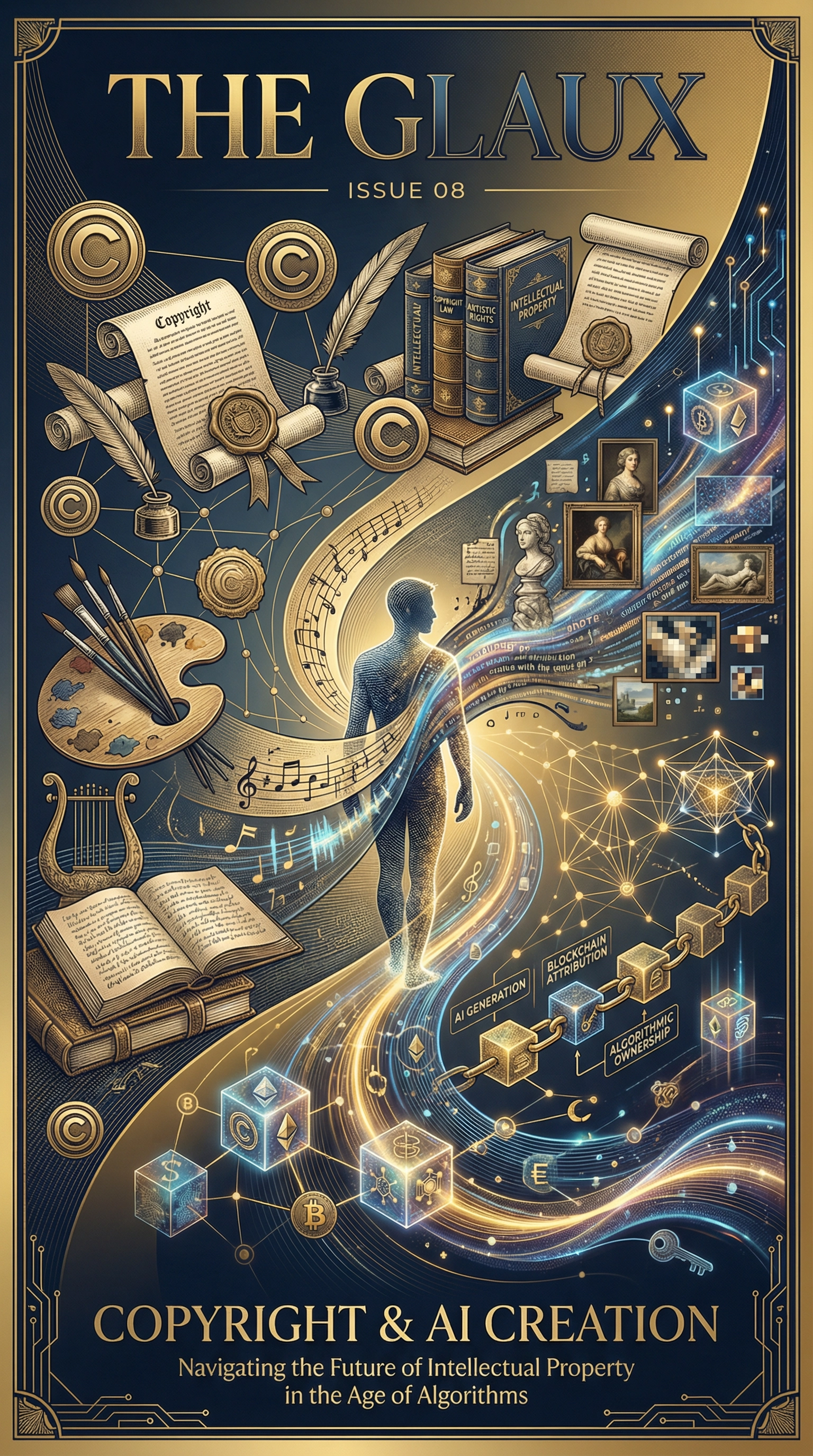
The innovation emerging in response to this impasse is a shift from ownership-based copyright to attribution-based frameworks. Rather than asking "who owns this work?" the question becomes "who contributed to this work, and how should they be recognized and compensated?"
This reframing is enabled by new technical and institutional mechanisms. Provenance tracking systems use cryptographic methods to record the lineage of AI-generated works, documenting which models were used, what data they were trained on, and who provided the prompts or inputs. Micro-licensing platforms allow creators to opt in to AI training in exchange for compensation, either through upfront payments or ongoing royalties based on usage. Attribution protocols embed metadata into AI outputs, making it possible to trace which training examples most influenced a given generation. Collective licensing schemes, similar to those used in music, create pools of compensation that are distributed to creators based on measurable contributions.
What makes this shift significant is that it moves beyond the binary of "infringement or fair use" and acknowledges that AI-generated works are inherently collaborative. They are the product of human prompters, model designers, training data contributors, and the algorithmic processes that synthesize these inputs. Rather than trying to identify a single author, the system recognizes multiple contributors and allocates rights and compensation accordingly. This does not eliminate conflict—determining the relative weight of each contribution is itself contentious—but it creates a framework for negotiation that the current system lacks.
This reframing also aligns with the reality of how generative AI is actually used. Most AI-generated content is not the product of a single, isolated act of creation. It is iterative, collaborative, and cumulative. A user refines a prompt through multiple generations, incorporates feedback, combines outputs from different models, and integrates AI-generated elements into larger works. The notion of a singular "author" is increasingly anachronistic. Attribution-based frameworks acknowledge this complexity and provide mechanisms for managing it.
What Shifts the Balance?
The transition from ownership to attribution is not inevitable. It depends on several factors that will determine which model prevails.
Judicial precedent is the most immediate variable. Courts in the United States, Europe, and elsewhere are currently adjudicating cases that will set the boundaries of fair use for AI training. If courts rule that training on copyrighted data requires permission, the industry will be forced to adopt licensing models. If they rule that training is transformative and protected, the attribution-based approach will gain momentum as a voluntary alternative. The outcomes of these cases will shape the legal landscape for decades.
Economic leverage also matters. Large AI companies have the resources to negotiate licensing deals with major content providers, but smaller firms and independent researchers do not. If the cost of legal compliance becomes prohibitive, innovation will concentrate in the hands of a few dominant players. Conversely, if attribution-based systems can be implemented at low cost and with minimal friction, they may become the default, even in the absence of legal mandates.
Creator collective action is another critical factor. If artists, writers, musicians, and other creators organize to demand compensation and control over how their work is used, they can shift the terms of the debate. Collective licensing schemes and industry-wide standards are more likely to emerge if creators present a unified front. However, if creators remain fragmented—some opting in to AI training, others opting out—the system will remain chaotic and contested.
Technological infrastructure will also play a role. Provenance tracking and attribution systems require robust technical standards and widespread adoption. If these systems are easy to implement and integrate into existing workflows, they will proliferate. If they are cumbersome, expensive, or incompatible with existing tools, they will remain niche solutions. The development of open-source attribution protocols could accelerate adoption, but only if they are supported by major platforms and model providers.
Finally, public perception will influence the trajectory. If the public views AI-generated content as legitimate and valuable, pressure to compensate creators may be limited. If there is widespread backlash against AI as exploitative or harmful to human creativity, regulatory and market forces may push toward more restrictive models. The narrative that emerges—whether AI is seen as a tool for democratizing creativity or as a threat to livelihoods—will shape policy and industry behavior.
The Ripples Through Creative Ecosystems
The shift from ownership to attribution will have profound second-order effects on creative industries, legal systems, and the broader economy.
Creative labor markets will be restructured. If attribution-based compensation becomes the norm, creators will need to adapt to a world where their income is derived not from selling discrete works, but from ongoing micro-payments tied to how their contributions are used in AI systems. This could provide a more stable income stream for some, but it also introduces new uncertainties. How will compensation be calculated? Who will administer these systems? What happens when a creator's work is used in ways they did not anticipate or approve?
Copyright law itself may undergo fundamental transformation. The concept of the "author" as a singular, identifiable human may be replaced by a more fluid notion of "contributorship." This would require new legal categories, new definitions of infringement, and new mechanisms for enforcement. The distinction between "original" and "derivative" works may blur, as AI-generated content is inherently derivative in some sense, yet also novel. Courts and legislatures will need to develop new doctrines to navigate this complexity.
Power dynamics within the creative industries will shift. If large platforms control the attribution infrastructure, they will have significant leverage over creators. They will decide which contributions are tracked, how compensation is calculated, and who has access to the data. This could lead to new forms of exploitation, where creators are nominally compensated but have little control over the terms. Alternatively, if attribution systems are decentralized and open-source, they could empower creators by giving them more transparency and agency.
Innovation in AI development may be constrained or redirected. If training on copyrighted data becomes legally or economically prohibitive, AI companies will focus on generating synthetic training data, licensing content, or developing models that require less data. This could slow progress in some areas, but it could also spur innovation in data efficiency and model design. The trajectory of AI research will depend on how the copyright question is resolved.
Cultural production will be affected in ways that are difficult to predict. If AI-generated content floods the market, human-created works may become more valuable as markers of authenticity and craftsmanship. Alternatively, the distinction between human and AI creation may become irrelevant, with audiences caring only about the quality of the output, not its origin. The role of the artist may shift from creator to curator, prompt engineer, or collaborator with AI systems.
Experiments in Progress
1. The Provenance Ledger. A consortium of AI companies, creative industry groups, and legal scholars could develop a standardized, blockchain-based system for tracking the lineage of AI-generated works. Every model, training dataset, and prompt would be logged, creating a transparent record of contributions. Creators could register their work in the ledger and receive compensation whenever it is used in training or generation. The system would be open-source and interoperable, preventing any single entity from controlling it. The challenge would be ensuring adoption across the industry and preventing circumvention by bad actors.
2. The Opt-In Training Pool. A platform could be created where creators voluntarily contribute their work to a shared training dataset in exchange for compensation. The pool would be managed by a neutral third party, and payments would be distributed based on measurable usage—how often a creator's work influenced a generation, how prominently it appeared in training, or how frequently users selected outputs derived from it. This would give creators control over whether their work is used, while still enabling AI development. The risk is that only a subset of creators would participate, limiting the diversity and quality of training data.
3. The Attribution Tax. Governments could impose a small levy on AI-generated content, similar to taxes on blank media or streaming services. The revenue would be distributed to creators whose work was used in training, based on audits of training datasets and usage patterns. This would provide a funding mechanism without requiring individual licensing deals. However, it would require international coordination, robust enforcement, and agreement on how to allocate funds fairly.
4. The Fair Use Certification. An independent body could be established to certify AI models as compliant with fair use standards. Models would need to demonstrate that their training processes are transformative, that they do not reproduce substantial portions of copyrighted works, and that they do not harm the market for the original works. Certification would provide legal safe harbor for AI companies and reassurance for creators. The challenge would be defining the standards and ensuring that the certification process is rigorous and impartial.
The Unsettled Terrain
The copyright dilemma in AI creation is not a problem that will be "solved" in any definitive sense. It is a site of ongoing negotiation, where legal, economic, and technological forces intersect. The shift from ownership to attribution offers a path forward, but it does not eliminate the underlying tensions. Questions of fairness, control, and compensation will remain contested.
What is clear is that the existing copyright framework is inadequate. It was built for a world where creation was human, discrete, and scarce. Generative AI operates on different principles—algorithmic, continuous, and abundant. The legal system must adapt, but adaptation is not the same as resolution. The terms of that adaptation—who benefits, who is harmed, what values are prioritized—are still being determined. The outcome will shape not only the future of AI, but the future of creativity itself.
Subscribe to The Glaux
Receive new issues directly to your inbox. Thoughtful explorations of innovation, technology, and human development — delivered when they matter.
What Should We Explore Next?
Each issue of The Glaux examines a single civilisational tension. If there is a topic you believe deserves that treatment, suggest it — or vote for ideas from the community.
Suggest a Topic →