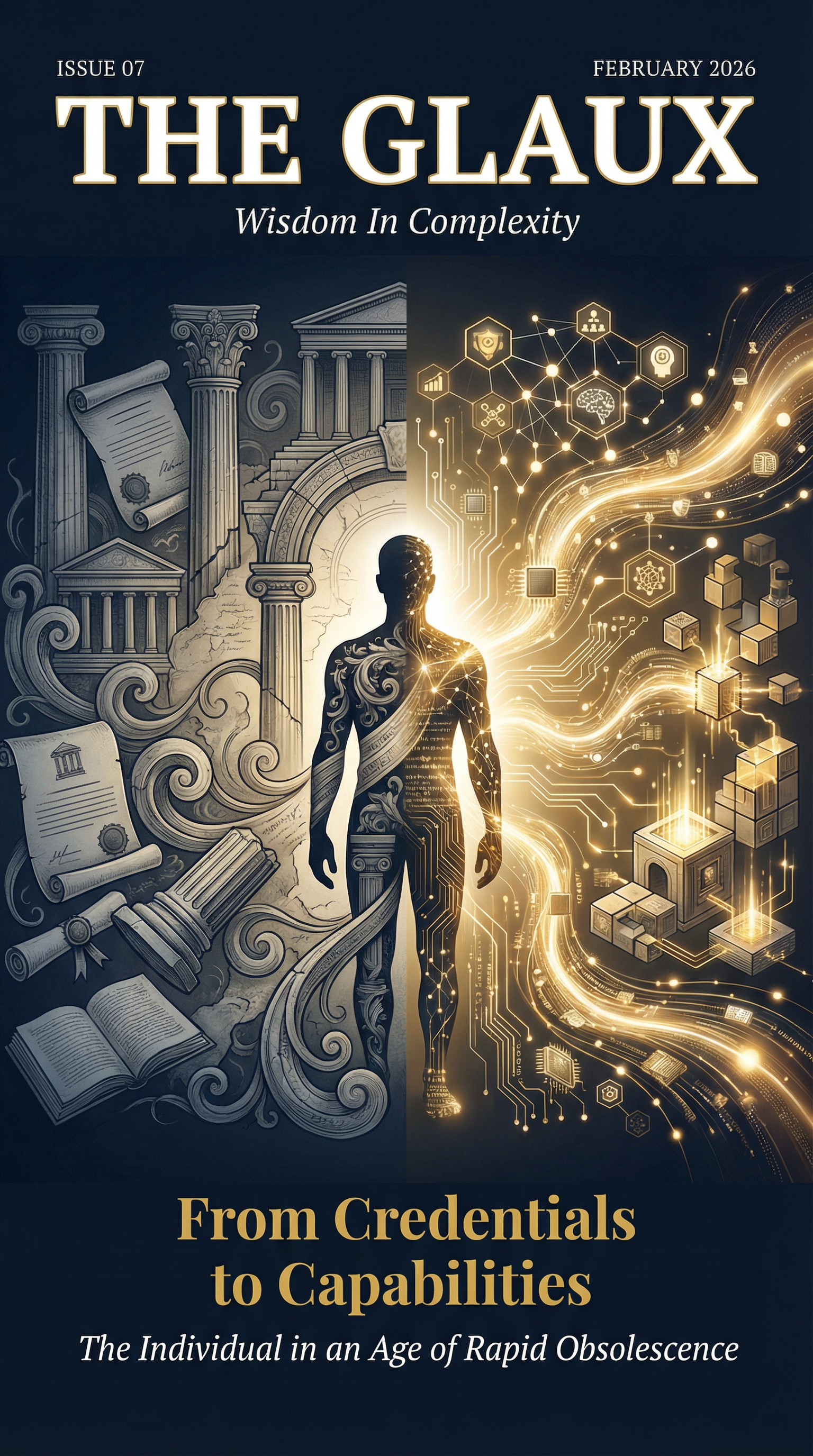
THE GLAUX
From Credentials to Capabilities
The Paradox of Preparation
The question of how individuals should prepare for the future of work contains a fundamental contradiction. On one hand, the pace of technological change—particularly in artificial intelligence, automation, and digital transformation—demands continuous adaptation and skill acquisition. Workers are told to "future-proof" their careers, to anticipate which skills will remain valuable, and to invest in education that will serve them for decades. On the other hand, the very nature of rapid change makes prediction unreliable. The skills that seem essential today may become obsolete tomorrow, and the jobs that will dominate in ten years may not yet exist. This creates a planning horizon problem: individuals must make long-term investments in their own development while operating in an environment of radical uncertainty.
This tension is not merely theoretical. It manifests in real decisions that millions of people face: Should a mid-career professional retrain in a technical field, knowing that the specific technologies they learn may be outdated within five years? Should a young person pursue a traditional university degree, or invest in shorter, more flexible credentials? Should workers focus on developing narrow, specialized expertise, or cultivate broad, general capabilities? The stakes are high. Education and training require significant investments of time, money, and opportunity cost. Choosing poorly can mean years of wasted effort and diminished economic security.
The traditional model of career development—acquire credentials early in life, apply them throughout a stable career, retire—no longer holds. Yet the institutions that govern education, employment, and professional development were designed for that model. Universities still structure degrees as multi-year commitments. Employers still use credentials as primary signals of competence. Labor markets still reward specialization and experience. Individuals are caught between a system that assumes stability and a reality defined by flux.
Two Inadequate Responses
The dominant responses to this dilemma fall into two camps, neither of which adequately addresses the underlying tension.
The first response is hyper-specialization: the belief that individuals should identify high-value, in-demand skills and master them deeply. This approach assumes that certain technical capabilities—coding, data analysis, AI prompt engineering—will remain valuable regardless of broader market shifts. Proponents argue that deep expertise creates defensible competitive advantage. If you become truly excellent at something scarce and valuable, you will remain employable even as the broader landscape shifts.
The problem with hyper-specialization is that it bets heavily on the durability of specific skills. History suggests this is a risky wager. Consider the fate of workers who specialized in now-obsolete technologies: COBOL programmers, typewriter repair technicians, film photography specialists. Many of these were once considered future-proof skills. The issue is not that specialization is inherently wrong, but that it creates brittleness. When the specific domain becomes obsolete, the specialist must start over. Moreover, hyper-specialization often comes at the cost of broader adaptability. The narrower the expertise, the harder it is to pivot when conditions change.
The second response is radical generalism: the belief that individuals should cultivate broad, transferable capabilities rather than narrow technical skills. This approach emphasizes meta-skills—critical thinking, communication, creativity, emotional intelligence—that are presumed to be durable across contexts. Proponents argue that these capabilities allow individuals to adapt to whatever the future brings. If you can think clearly, learn quickly, and work well with others, you can navigate any transition.
The problem with radical generalism is that it undervalues the importance of specific, demonstrable competence. In competitive labor markets, employers need signals of ability. General capabilities are hard to assess and harder to credential. A resume that lists "critical thinking" and "adaptability" is less compelling than one that demonstrates concrete achievements in a recognizable domain. Moreover, many high-value opportunities require deep domain knowledge. You cannot simply "think critically" your way into a complex technical field without investing in the specific knowledge and skills that field requires.
Both approaches contain truth, but neither resolves the core tension. Specialization without adaptability creates fragility. Generalism without demonstrable competence creates invisibility. Individuals need a framework that allows them to navigate between these poles, adjusting their strategy as conditions change.
The Shift from Credentials to Capabilities
The innovation emerging in response to this tension is a fundamental reframing of how competence is signaled and validated. Rather than relying primarily on traditional credentials—degrees, certifications, job titles—the labor market is beginning to shift toward capability-based assessment. This shift is enabled by new technologies and platforms that allow individuals to demonstrate what they can actually do, rather than simply what they have studied.
This reframing manifests in several forms. Portfolio-based hiring allows workers to showcase actual work products—code repositories, design projects, writing samples—rather than relying solely on resumes. Micro-credentials and skill badges break down traditional degrees into smaller, more modular units that can be acquired incrementally and combined flexibly. Project-based platforms (such as freelance marketplaces and open-source communities) create environments where individuals can build reputation through demonstrated performance rather than formal credentials. AI-assisted skill assessment tools enable more granular and objective evaluation of specific capabilities, reducing reliance on proxies like university prestige or years of experience.
What makes this shift significant is that it changes the unit of analysis from static credentials to dynamic capabilities. A traditional degree is a one-time signal, acquired early in life and carried forward. A capability-based profile is continuously updated, reflecting recent work, new skills, and evolving expertise. This creates a more accurate and responsive signal of current competence. It also reduces the penalty for non-traditional paths. Individuals who learn through unconventional means—online courses, self-study, apprenticeships—can demonstrate their abilities directly, without needing to retrofit their experience into traditional credential formats.
This does not mean that traditional credentials will disappear. Universities, professional certifications, and formal training programs still serve important functions: they provide structure, accountability, peer networks, and depth of knowledge. But they are no longer the exclusive gatekeepers of opportunity. The labor market is becoming more pluralistic, recognizing multiple pathways to competence.
How the Weights Shift
The transition from credentials to capabilities is not automatic or uniform. It depends on several factors that shift the balance between the old and new models.
Employer risk tolerance is a critical variable. Hiring based on demonstrated capabilities rather than traditional credentials requires employers to invest more effort in evaluation. It is easier to filter candidates by degree and GPA than to assess portfolios and conduct skill-based interviews. Employers will adopt capability-based hiring when the benefits—access to a broader talent pool, better matches between skills and roles—outweigh the costs. This is more likely in industries where talent is scarce, where traditional credentials are poor predictors of performance, or where innovation is highly valued.
Technology infrastructure also matters. Capability-based assessment requires platforms that can aggregate, verify, and present evidence of competence in standardized, trustworthy ways. Blockchain-based credential systems, AI-powered skill assessments, and reputation platforms all contribute to making this model viable. As these technologies mature and become more widely adopted, the friction of capability-based hiring decreases.
Regulatory and institutional support can accelerate or hinder the transition. Governments and professional bodies that recognize alternative credentials, fund skill-based training programs, and reduce barriers to non-traditional pathways make it easier for individuals to build capabilities outside traditional institutions. Conversely, regulations that mandate specific degrees for certain roles, or funding structures that privilege traditional universities, slow the shift.
Individual agency and risk appetite also play a role. Pursuing a capability-based path requires individuals to take on more responsibility for their own development. They must actively build portfolios, seek out learning opportunities, and navigate a more fragmented and uncertain landscape. This is easier for those with financial stability, social capital, and high tolerance for ambiguity. For others, the structure and predictability of traditional pathways may remain more attractive, even if less optimal.
The result is a labor market in transition, where both models coexist and compete. Some sectors and roles will shift rapidly toward capability-based assessment. Others will remain anchored to traditional credentials. Individuals must navigate this hybrid environment, making strategic choices about where to invest their time and how to signal their value.
The Ripples of a Capability-Driven World
If the shift from credentials to capabilities continues, it will generate second-order effects that extend beyond individual career strategies.
Educational institutions will face pressure to unbundle and modularize. Universities that offer only traditional four-year degrees may lose market share to more flexible providers. This could lead to greater innovation in higher education—more online programs, more competency-based degrees, more partnerships with industry. But it could also exacerbate inequality. Students from privileged backgrounds may be better positioned to navigate a fragmented educational landscape, while those from disadvantaged backgrounds may struggle without the structure and support of traditional institutions.
Labor market inequality may shift in unexpected ways. On one hand, capability-based hiring could reduce credentialism and open opportunities to non-traditional candidates. On the other hand, it could create new forms of stratification. Those who are skilled at self-promotion, portfolio curation, and personal branding may thrive, while those who are competent but less visible may struggle. The shift could also disadvantage older workers, who may find it harder to build digital portfolios or adapt to new assessment methods.
The nature of professional identity may change. In a world where careers are less linear and credentials less permanent, individuals may develop more fluid, project-based identities. This could be liberating—allowing people to reinvent themselves, pursue multiple interests, and avoid being locked into narrow roles. But it could also be destabilizing, eroding the sense of continuity and belonging that comes from long-term affiliation with a profession or institution.
Employers may gain more power in defining what counts as competence. If traditional credentials lose their gatekeeping function, employers become the primary arbiters of what skills matter. This could lead to more efficient matching between skills and roles. But it could also lead to exploitation, with employers demanding ever-narrower, more specific capabilities and shifting the burden of training onto individuals. Without collective standards or institutional mediation, workers may find themselves in a perpetual race to meet employer-defined benchmarks.
Navigating the Uncertainty
Given these dynamics, what strategies might individuals adopt to navigate the future of work? No single approach will work for everyone, but several plausible pathways emerge.
1. The Adaptive Specialist. This approach involves developing deep expertise in a specific domain while deliberately cultivating adjacent skills and maintaining awareness of how the domain is evolving. The goal is to be excellent at something valuable today, while building the capacity to pivot if that domain shifts. This requires ongoing investment in learning, active participation in professional communities, and willingness to periodically reassess one's trajectory. The risk is that the domain changes faster than the individual can adapt, or that adjacent skills prove insufficient for a meaningful pivot. The advantage is that deep expertise remains valuable in most contexts, and the ability to demonstrate mastery creates options.
2. The Portfolio Careerist. This approach involves building a diverse set of capabilities and income streams, rather than committing to a single career path. Individuals might combine freelance work, part-time roles, project-based engagements, and entrepreneurial ventures. The goal is to reduce dependence on any single employer or skill set, creating resilience through diversification. This requires strong self-management, comfort with uncertainty, and the ability to market oneself across multiple contexts. The risk is fragmentation—spreading effort too thinly and never developing deep expertise in anything. The advantage is flexibility and reduced exposure to single points of failure.
3. The Institutional Navigator. This approach involves strategically using traditional institutions—universities, professional associations, large employers—as platforms for development, while supplementing them with non-traditional learning and capability-building. The goal is to gain the credibility and structure that institutions provide, while avoiding over-dependence on them. This might involve pursuing a degree while also building a portfolio, or working for a large employer while developing side projects. The risk is that the individual becomes trapped in institutional inertia, unable to break free when conditions change. The advantage is that institutions provide resources, networks, and legitimacy that are hard to replicate independently.
4. The Meta-Learner. This approach focuses on developing the capacity to learn quickly and effectively, rather than accumulating specific skills. Individuals invest in understanding how they learn best, building habits of continuous improvement, and cultivating intellectual curiosity. The goal is to become someone who can acquire new capabilities on demand, rather than trying to predict which capabilities will be needed. This requires discipline, self-awareness, and access to high-quality learning resources. The risk is that meta-learning alone is not sufficient—employers still need evidence of specific competence. The advantage is that the ability to learn is perhaps the most durable capability of all.
Each of these approaches involves trade-offs. None is universally superior. The right strategy depends on individual circumstances, risk tolerance, and the specific dynamics of the sectors and roles one is navigating. What they share is a recognition that the future of work requires individuals to take more active responsibility for their own development, to remain alert to changing conditions, and to build both depth and adaptability.
The Question That Remains
The shift from credentials to capabilities does not resolve the fundamental tension at the heart of individual preparation for the future of work. It changes the terms of the problem, but it does not eliminate the uncertainty. Individuals still face the challenge of making long-term investments in an environment of short-term unpredictability. They still must balance specialization and generalism, structure and flexibility, institutional pathways and independent initiative.
What remains unresolved is the question of collective responsibility. To what extent should individuals bear the burden of navigating rapid change, and to what extent should institutions—employers, governments, educational systems—provide support, structure, and safety nets? A purely individualistic model places enormous pressure on workers to constantly adapt, often without the resources or stability to do so effectively. A purely institutional model risks creating rigidity and stifling innovation. The challenge is to design systems that enable individual agency while providing collective support—that allow people to take risks without facing catastrophic consequences, and that reward adaptation without punishing those who cannot keep pace.
The future of work is not a fixed destination. It is a continuous process of adjustment, negotiation, and redesign. Individuals, institutions, and markets are all learning how to navigate this terrain. The question is not whether change will continue—it will—but how we collectively manage the costs and benefits of that change, and whether we can build systems that allow more people to thrive in an age of perpetual transition.
Subscribe to The Glaux
Receive new issues directly to your inbox. Thoughtful explorations of innovation, technology, and human development — delivered when they matter.
What Should We Explore Next?
Each issue of The Glaux examines a single civilisational tension. If there is a topic you believe deserves that treatment, suggest it — or vote for ideas from the community.
Suggest a Topic →