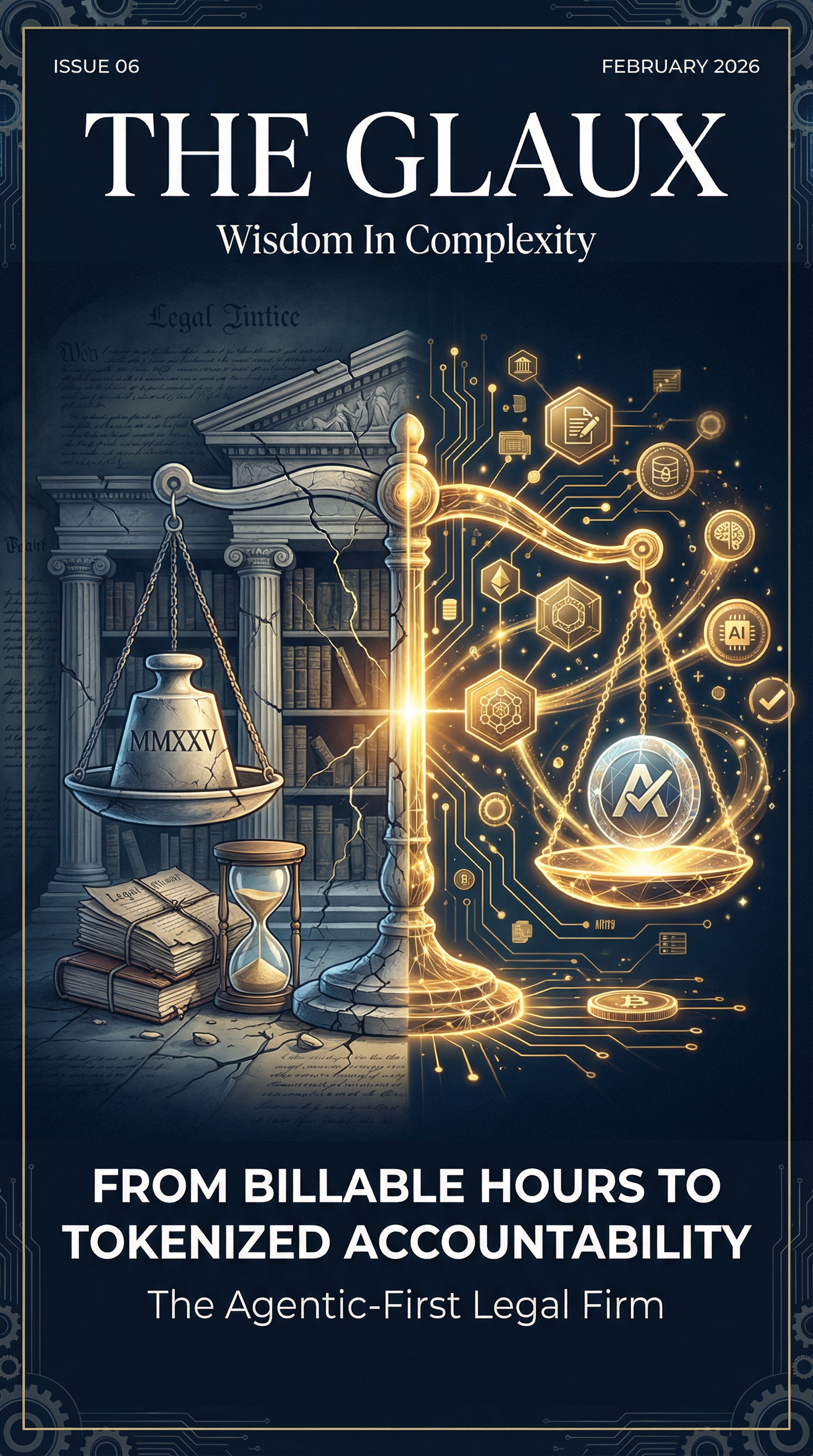
THE GLAUX
From Billable Hours to Tokenized Accountability
The End of the Billable Hour?
The legal industry, long anchored to the monetization of time and human expertise, stands at a precipice. For centuries, law firms have operated on a simple economic model: charging for the hours their lawyers work, the documents they produce, and the access they provide to specialized knowledge. Even as technology has permeated the field, the fundamental premise has remained unchanged. Legal-tech platforms, for all their sophistication, still largely function as tools to assist human lawyers, offering more efficient access to databases and research materials. The client, ultimately, pays for labor.
However, the rise of agentic artificial intelligence presents a structural challenge to this age-old paradigm. The next evolution is not merely "AI assisting lawyers" but a more profound transformation: legal firms operating as autonomous compliance and risk agents. In this new model, the core service is not legal advice, but continuous legal risk infrastructure, and the economic layer that enables this shift is tokenization. This article outlines how tokenized accountability is poised to become the business model for the next generation of legal services, moving the industry from selling labor to selling structured, verifiable outcomes.
Two Sides of the Same Coin
The traditional model of legal services, based on the billable hour, is increasingly showing its limitations in a world of accelerating complexity. It incentivizes inefficiency, scales poorly, and places the bulk of the risk on the client. The firm's revenue is tied to the process of legal work, not the outcome. This creates a fundamental misalignment of interests, where the firm profits from complexity and ambiguity, rather than from clarity and resolution.
On the other hand, a purely automated, AI-driven legal service, devoid of human accountability, presents its own set of problems. While AI agents can monitor, analyze, and execute tasks with superhuman efficiency, they lack the nuanced judgment, ethical reasoning, and ultimate accountability that complex legal matters demand. A system without a "ringable neck"—a designated point of human responsibility—is a system that cannot be fully trusted with high-stakes decisions. Both the legacy human-only model and a hypothetical AI-only model represent absolutist solutions that fail to address the core need for scalable, accountable, and aligned legal services.
The Token as a Contract
The innovation that bridges this gap is the tokenization of legal services. In this context, tokenization is not about speculative cryptocurrencies, but about the financial encoding of legal risk, compliance obligations, and contractual guarantees into measurable, digital units. It provides a new language for quantifying and managing legal exposure. Each contract can be risk-scored, each regulatory domain continuously monitored, and each compliance obligation made programmable.
Tokens, in this framework, represent tangible units of legal service and accountability. They can signify units of monitored legal exposure, compliance performance credits, risk mitigation guarantees, or rights to escalate issues to human experts. Instead of selling amorphous blocks of time, the agentic-first firm sells a far more valuable commodity: structured, accountable risk coverage. The token becomes a new kind of contract, one that is dynamic, transparent, and directly tied to the value it provides.
The New Architecture of Trust
This tokenized model gives rise to a new three-layered architecture for legal services. The first layer consists of Autonomous Legal Agents, AI systems that operate 24/7, continuously monitoring regulatory changes, analyzing contracts, flagging exposures, and even simulating litigation risks. This is the infrastructure layer, providing constant, scalable vigilance.
The second layer is Human Oversight and Escalation. This consists of named legal experts who review high-risk flags, validate complex interpretations, and provide bespoke strategic counsel. They are the accountable humans in the loop, the "ringable necks" who assume formal responsibility for the system's outputs.
The third and final layer is the Tokenized Economic Layer. This is where clients purchase, hold, or trade tokens that represent their desired level of compliance coverage, risk monitoring, or advisory capacity. This layer aligns the economic incentives of the firm and the client. The firm is rewarded not for the hours it bills, but for its effectiveness in managing the client's risk. This new architecture of trust is built on a foundation of verifiable performance and shared accountability.
The Ripples of Restructured Risk
The shift to a tokenized, agentic-first model will have profound second-order effects on the legal industry and beyond. It transforms the legal firm from a service provider into a hybrid of law firm, compliance operator, and risk underwriter. The firm's core asset is no longer just the expertise of its lawyers, but its proprietary legal datasets, its historical case intelligence, and its willingness to assume a portion of its clients' risk.
This model also changes the nature of competition. The competitive advantage lies not in having the most sophisticated AI model, but in the ability to structure measurable risk units, design enforceable accountability mechanisms, and build the capital reserves necessary to backstop the guarantees offered. Firms that succeed in this new paradigm will likely resemble regulated financial institutions or insurance companies more than traditional legal partnerships. This could lead to a consolidation of the industry, as smaller firms may lack the resources to build and maintain such a capital-intensive infrastructure.
What Could Be Tried
1. The Compliance-as-a-Service Utility. A consortium of firms could create a shared, regulated utility that provides baseline, continuous regulatory monitoring for specific industries (e.g., fintech, healthcare). Clients would subscribe to this service, holding tokens that represent their share of the monitoring infrastructure. The utility would be responsible for maintaining the AI agents and the underlying data, while member firms would provide the human oversight and escalation services. This would allow smaller firms to compete by leveraging a shared infrastructure.
2. The Contractual Risk Index. A specialized firm could develop a standardized index for scoring the risk of common legal contracts (e.g., SaaS agreements, M&A term sheets). This index, backed by extensive data analysis, could become an industry benchmark. The firm would sell tokens that grant access to this platform, allowing clients to score their own contracts and purchase guarantees against specific, identified risks. This would create a more transparent and liquid market for contractual risk.
3. The Litigation Exposure Pool. A group of corporate clients could form a mutual insurance pool to cover the costs of common types of litigation. The pool would be managed by an agentic-first legal firm, which would use its AI platform to assess risk, manage cases, and distribute funds. Members would contribute to the pool based on their risk profile, and would hold tokens representing their share of the pool's assets and their rights to its services. This would allow clients to better predict and manage their litigation expenses.
The Unwritten Contract
The transition from billable hours to tokenized accountability represents a fundamental philosophical shift in the nature of legal services. The deepest transformation is from selling expertise to selling certainty, speed, and liability-backed decisions. Clients are no longer just buying advice; they are buying managed exposure, reduced uncertainty, and programmable legal coverage.
While the technological and economic frameworks for this transition are beginning to emerge, the ethical and regulatory frameworks are still largely unwritten. How do we ensure that these agentic systems are aligned with legal ethics? How do we regulate firms that are also, in effect, financial institutions? And what becomes of the traditional role of the lawyer in a world where legal services are increasingly delivered by autonomous agents? The firms that can answer these questions will not merely be adopting AI; they will be redesigning the economic and ethical architecture of the law itself. The unwritten contract between the legal profession and society is up for renegotiation, and its terms are yet to be determined.
Subscribe to The Glaux
Receive new issues directly to your inbox. Thoughtful explorations of innovation, technology, and human development — delivered when they matter.
What Should We Explore Next?
Each issue of The Glaux examines a single civilisational tension. If there is a topic you believe deserves that treatment, suggest it — or vote for ideas from the community.
Suggest a Topic →